Acceleration
AWD vs RWD Launch: Exactly Where the Advantage Ends
All wheel drive can use the whole car as ballast, which is worth up to a second to 100 km/h. Above the traction limit speed the advantage becomes a weight penalty instead.
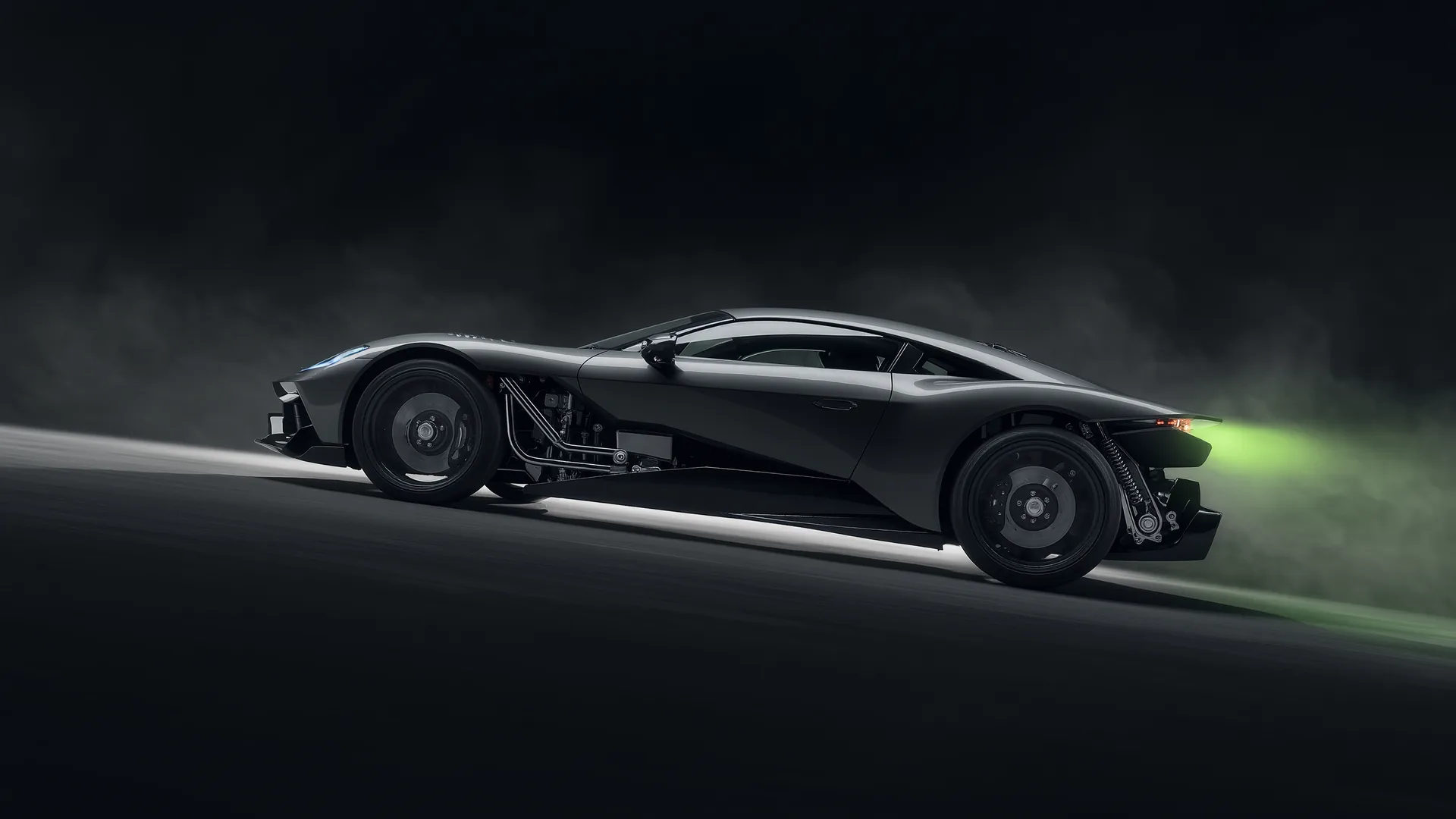
All wheel drive wins the launch because it can put every kilogram of the car onto a driven wheel. A rear wheel drive car can only use what sits on its rear axle, which is 48 to 61 per cent of the mass depending on where the engine is. The gap is worth up to 1.0 s to 100 km/h on identical tyres, and it closes to nothing at the speed where the engine, rather than the rubber, becomes the limit.
The mechanism, in one equation each
For an all wheel drive car, every wheel is driven, so the maximum forward force is the friction coefficient multiplied by the whole weight, and maximum acceleration is simply a = μg. Mass cancels, so a heavy all wheel drive car reaches the same launch ceiling as a light one.
For rear wheel drive the usable load is the static rear weight plus whatever weight transfer adds during the launch, and that creates a feedback loop that resolves to
a = μ · g · f / (1 − μ · h / L)
with f the static rear weight fraction, h the centre of gravity height and L the wheelbase. The denominator is the transfer term: a tall car with a short wheelbase transfers more, which helps a rear driven car and is one of the reasons a rear engined layout launches out of proportion to its power.
| Drive and layout | Static rear weight | Acceleration limit | 0 to 100 km/h at that limit | Gap to AWD |
|---|---|---|---|---|
| All wheel drive | not relevant | 11.28 m/s² | 2.46 s | reference |
| Rear wheel drive, rear engine | 61 % | 8.72 m/s² | 3.18 s | +0.72 s |
| Rear wheel drive, mid engine | 57 % | 7.86 m/s² | 3.53 s | +1.07 s |
| Rear wheel drive, front engine | 48 % | 6.78 m/s² | 4.10 s | +1.64 s |
The mid engined car sitting behind the rear engined one surprises people, and it is a real effect: a longer wheelbase and a lower centre of gravity both reduce weight transfer, which is excellent for braking and cornering balance and mildly unhelpful for a standing start.
Where the advantage ends
Traction stops being the limit at the speed where the engine can no longer supply the force the tyres would accept. That crossover is v = P / (μmg) for an all wheel drive car, and it arrives earlier for a rear wheel drive car because its usable force is lower.
- A 1,600 kg all wheel drive car with 400 kW at the wheels on a μ = 1.15 tyre is traction limited only to 19.8 m/s, 71 km/h. Beyond that speed the drive layout no longer sets the ceiling.
- The equivalent front engined rear wheel drive car leaves its traction limit at about 43 km/h, and from there both cars are power limited and behave the same way.
- By 150 km/h the drive layout contributes nothing to straight line acceleration at all. What remains is the weight of the hardware.
That last point is the honest counterweight. A transfer case, a front differential, a propshaft and front driveshafts add roughly 60 to 90 kg, and they also add drivetrain friction. Above the traction limited region that mass is pure cost, which is why a rear driven car frequently wins a 100 to 200 km/h run against an all wheel drive car it lost to from rest.
What modern systems changed, and what they did not
Contemporary all wheel drive is usually rear biased with an electronically controlled coupling, and it can send anything from almost nothing to a large share of torque forward within a few tens of milliseconds. That improves handling balance and it improves launch consistency on mixed surfaces, because the system can find grip rather than assume it.
It does not change the ceiling. The maximum force still equals the friction coefficient multiplied by the load on driven wheels, and no amount of torque distribution creates load that is not there. A rear biased system launching with 70 per cent of torque at the back is, at that instant, a rear wheel drive car with help.
Electric cars complicate the comparison rather than settling it. A dual motor layout is all wheel drive with no propshaft and per axle torque control at millisecond resolution, which is close to ideal for a launch. The battery that feeds it, though, is the weight penalty in a different place, and it does not come off for the 100 to 200 km/h run.
Questions readers ask
How much quicker is all wheel drive off the line?
On identical tyres, 0.7 s to 100 km/h against a rear engined car, 1.1 s against a mid engined one and 1.6 s against a front engined rear wheel drive car. The gap comes purely from how much of the vehicle's mass sits over a driven wheel.
At what speed does the all wheel drive advantage disappear?
At the traction limit speed, v = P / (μmg). For a 1,600 kg car with 400 kW at the wheels on a good road tyre that is about 71 km/h. Above it the engine is the constraint, both layouts are power limited, and by 150 km/h the drive layout contributes nothing.
Why does a rear engined car launch better than a mid engined one?
More static weight over the rear axle, 61 per cent against 57 per cent in typical layouts, and a shorter wheelbase that transfers more weight rearward under acceleration. Both effects add load to the driven tyres exactly when it is needed.
What does all wheel drive cost?
Roughly 60 to 90 kg of hardware plus additional drivetrain friction. Below the traction limit that mass is free, because acceleration at the grip limit is μg regardless of weight. Above it, the mass is a straight penalty, which is why rear driven cars often win rolling start comparisons.
Does torque vectoring raise the traction limit?
No. It distributes torque more intelligently and improves consistency on uneven grip, but maximum force is still the friction coefficient multiplied by the load on driven wheels. Control strategy decides how close you get to the ceiling, never where the ceiling sits.
Sources
- Autosport technical forum, tyre coefficient of friction, on measured friction values for road and racing tyres.
- Vehicle Physics Pro, tyre model documentation, on load sensitivity and how grip responds to weight transfer.
- Tire friction overview, on the relationship between vertical load and available friction.
Figures assume a 1,600 kg vehicle, g = 9.81 m/s², a friction coefficient of 1.15 and no aerodynamic downforce. Rear wheel drive limits use a = μgf / (1 − μh/L) with the layout values given in the table.