Acceleration
What Every Gearshift Costs in a 0 to 100 Run
A dual clutch shift interrupts drive for 20 to 100 ms, but the real cost is the speed lost during it. Two shifts to 100 km/h are worth roughly a tenth, and the ratio choice is worth more.
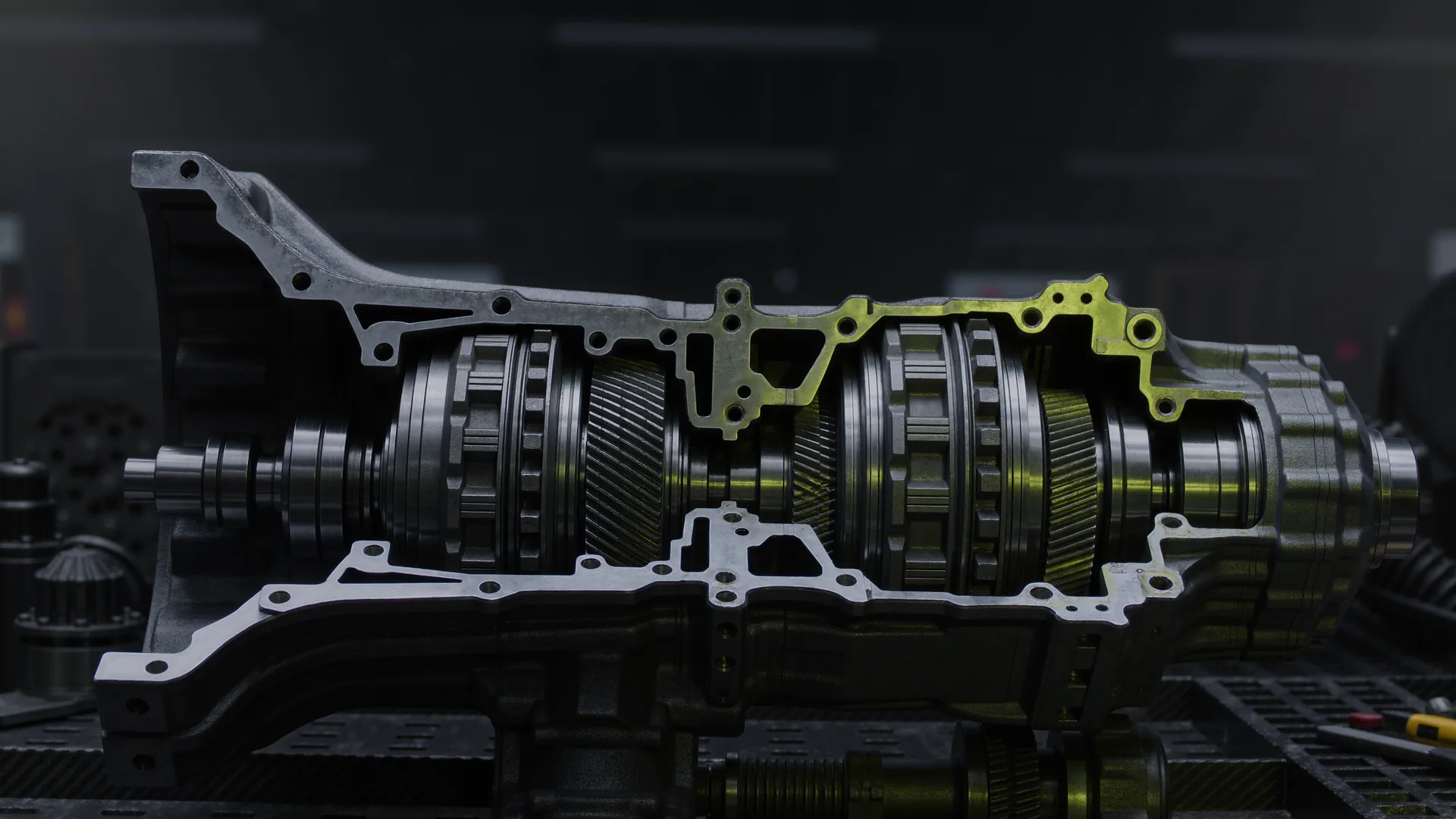
A gearshift costs time in two ways, and the smaller one gets all the attention. The interruption itself lasts 20 to 100 ms in a dual clutch gearbox and up to 500 ms in a hand shifted one. The larger cost is that the engine drops away from peak power afterwards, so the car spends the next stretch making less than it could. On a run to 100 km/h with two shifts, the total is typically 0.08 to 0.35 s.
What actually happens during the shift
A dual clutch gearbox preselects the next ratio on the second shaft, so the shift is a handover between two clutches rather than a disengagement and reengagement. During the handover, torque at the wheels dips but rarely reaches zero, which is why the published shift figures are so short. A single clutch automated manual, a torque converter automatic without a lock-up strategy for shifts, and a hand shifted manual all have a genuine gap where no torque reaches the road.
The cost of the gap is straightforward. While drive is interrupted the car does not accelerate, and it also decelerates slightly under drag and rolling resistance. At around 60 km/h a typical car sheds roughly 0.3 m/s² when coasting, so a 30 ms gap costs the acceleration that would have happened plus a small loss.
| Gearbox type | Interruption | Speed not gained | Distance behind | Time penalty per shift |
|---|---|---|---|---|
| Dual clutch, aggressive map | 20 ms | 0.18 m/s | 0.002 m | ≈0.02 s |
| Dual clutch, comfort map | 100 ms | 0.90 m/s | 0.045 m | ≈0.10 s |
| Single clutch automated | 250 ms | 2.25 m/s | 0.28 m | ≈0.25 s |
| Manual, expert driver | 350 ms | 3.15 m/s | 0.55 m | ≈0.35 s |
| Manual, ordinary driver | 700 ms | 6.30 m/s | 2.2 m | ≈0.70 s |
The ratio choice matters more than the shift speed
Between shifts, an engine sweeps its power curve, and it only makes peak power at one engine speed. A wide ratio gearbox drops the engine a long way down that curve after each shift, so the car spends more of the run away from its best output. A close ratio set keeps the engine near peak power but needs more shifts to cover the same speed range.
The way to see this clearly is average power delivered rather than peak power quoted. A car that holds 90 per cent of peak power across the run does more work than one that averages 78 per cent, even if the second one has the higher headline figure. That difference is worth far more than the difference between a 20 ms and a 100 ms shift.
- Where the shift lands relative to 100 km/h decides a lot. A car that reaches 100 km/h just before a shift is flattered. A car forced to change gear at 96 km/h and complete the shift before the clock stops carries the full penalty inside the measurement.
- A tall first gear removes a shift. Some performance cars are geared so first gear runs past 100 km/h, which is worth an entire shift penalty in the headline figure and costs nothing anywhere else.
- Electric cars usually shift once or not at all. A single speed reduction gear means no interruption exists, which is part of why electric acceleration feels seamless and why the comparison is not like for like.
Adding it up for a real run
A typical performance car reaching 100 km/h uses first and second and touches third, so two shifts fall inside the measurement. With a dual clutch gearbox on an aggressive map, that is roughly 0.04 to 0.08 s, small enough to be inside the run to run scatter of the tyres. With a hand shifted manual and an ordinary driver, it is 1.4 s, which is not a measurement difference, it is a different car.
This is why manufacturers stopped quoting manual gearbox acceleration figures alongside automatic ones as though they were comparable, and why a manual version of a car is usually listed several tenths slower despite having identical power. The engine did not change. The number of interruptions did.
Questions readers ask
How long does a dual clutch gearshift take?
Between about 20 and 100 ms depending on the calibration, and torque rarely falls all the way to zero because the next ratio is already engaged on the second shaft. Comfort maps sit at the slow end of that range deliberately, so the same car shifts faster in its sport setting.
How much time does a gearshift cost in a 0 to 100 km/h run?
Roughly 0.02 to 0.10 s per shift for a dual clutch gearbox and 0.35 to 0.70 s for a manual, depending on the driver. With two shifts inside the run, that is 0.04 to 0.20 s for the dual clutch and up to 1.4 s for a hand shifted car.
Why is the manual version of a car always slower?
Not because it has less power, but because it has longer interruptions. A good manual shift takes 300 to 500 ms against 20 to 100 ms for a dual clutch, and there are two or three shifts inside a run to 100 km/h.
Does gear ratio choice matter more than shift speed?
Usually yes. The interruption is measured in hundredths, while ratio spacing decides how much of the run the engine spends away from peak power, which can be worth ten per cent or more of the average power delivered across the whole run.
Why do some cars reach 100 km/h in first or second gear?
Because it removes a shift from the measured run. Gearing that carries past 100 km/h before a change is required saves the full shift penalty in the headline figure, which is a legitimate design choice and one worth knowing about when comparing two cars with similar power.
Sources
- 0 to 60 mph, on how transmission type and shift count affect published acceleration figures.
- Quarter mile calculator, on the power and acceleration relationships used to convert an interruption into a time penalty.
- Quarter mile elapsed time and speed formulas, on why average delivered power rather than peak power sets a run's outcome.
Penalties are calculated at an acceleration of 9 m/s² and a speed of 60 km/h, with a coasting deceleration of 0.3 m/s² during the interruption. Shift durations are representative ranges for each gearbox type rather than figures from a single manufacturer.