Acceleration
The Traction Limit: Why 1,000 hp Cannot Beat Physics
Below 100 km/h a car is limited by tyre grip, not power. On a road tyre an all wheel drive car cannot use more than about 585 hp, and everything above that is stored for later.
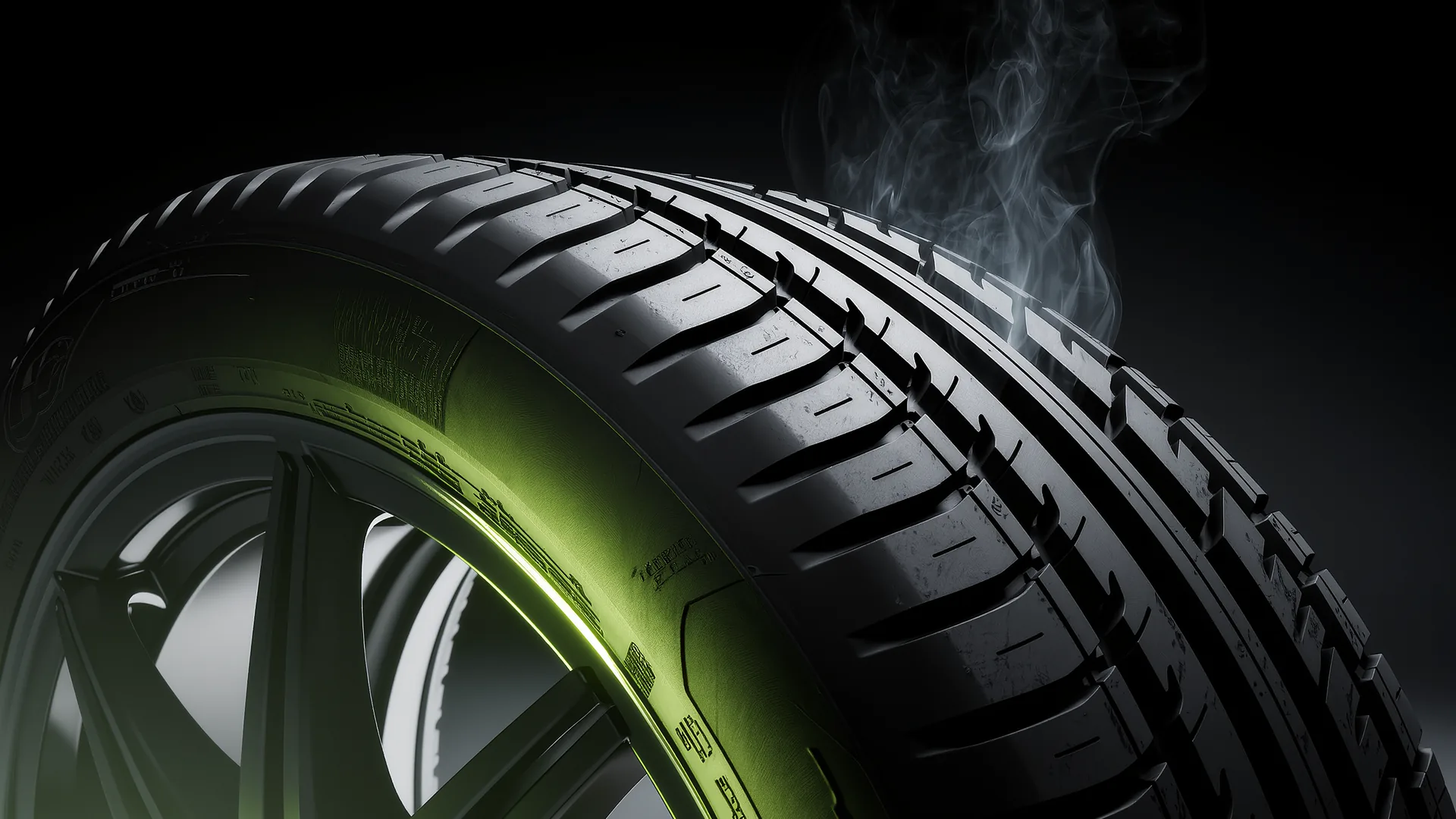
Under about 100 km/h, acceleration is set by how much force the tyres can put down, not by how much the engine makes. For an all wheel drive car on a good road tyre with a friction coefficient near 1.0, the ceiling is 9.81 m/s², which is a 0 to 100 km/h time of 2.83 s and needs only 436 kW, about 585 hp, at the wheels. Every horsepower beyond that does nothing until the car is already moving fast.
The ceiling is a friction number
The forward force a tyre can generate is the vertical load on it multiplied by the friction coefficient between rubber and road. For an all wheel drive car, every kilogram of the car sits on a driven wheel, so the maximum forward force is the whole weight multiplied by that coefficient, and the maximum acceleration is simply μg. Mass cancels out entirely, which is why a heavy all wheel drive car and a light one hit the same launch ceiling.
Published friction values for treaded street tyres sit around 0.7 to 1.0, historic racing tyres around 1.3, and modern slicks between 1.5 and 2.0 on dry asphalt. Formula 1 tyres have been measured at 1.875 at the front. The gap between a road tyre and a slick is therefore close to a factor of two, which is a larger performance lever than anything available in the engine bay.
| Tyre | Friction coefficient | Maximum acceleration | 0 to 100 km/h | Wheel power needed at 100 km/h |
|---|---|---|---|---|
| Ordinary road tyre | 0.85 | 8.34 m/s² | 3.33 s | 371 kW, 497 hp |
| Good performance road tyre | 1.00 | 9.81 m/s² | 2.83 s | 436 kW, 585 hp |
| Track focused semi slick | 1.30 | 12.75 m/s² | 2.18 s | 567 kW, 760 hp |
| Slick or drag radial | 1.70 | 16.68 m/s² | 1.67 s | 741 kW, 994 hp |
Read the last column carefully. It is the power needed at the top of the run, where speed is highest, and it is the peak requirement, not the average. Averaged over the whole run to 100 km/h the same car needs only about 218 kW, 292 hp. A 1,000 hp car and a 600 hp car with identical tyres and identical all wheel drive systems will post very similar 0 to 100 times, because both are pressing against the same rubber.
Rear wheel drive, and why the engine position decides the launch
A rear wheel drive car can only use the load sitting on its rear axle. That load is not fixed: accelerating transfers weight rearward, which adds grip, which allows more acceleration, which transfers more weight. Solving that loop gives
a = μ · g · f / (1 − μ · h / L)
where f is the static rear weight fraction, h the centre of gravity height and L the wheelbase. The denominator is the reason a car with its mass low and its wheelbase long transfers less usefully, and the numerator is the reason a rear engined car launches so well.
| Layout | Static rear weight | CG height | Wheelbase | Limit | 0 to 100 km/h |
|---|---|---|---|---|---|
| Rear engine | 61 % | 0.45 m | 2.45 m | 8.72 m/s² | 3.18 s |
| Mid engine | 57 % | 0.42 m | 2.65 m | 7.86 m/s² | 3.53 s |
| Front engine GT | 48 % | 0.50 m | 2.85 m | 6.78 m/s² | 4.10 s |
| All wheel drive, same tyre | 100 % driven | irrelevant | irrelevant | 11.28 m/s² | 2.46 s |
Nearly a second separates the rear engined car from the front engined GT on identical tyres with identical power, purely from where the mass sits. It is also why the same front engined GT often beats both once the road opens up: the traction limit stops mattering above about 100 km/h, and from there the power figure takes over.
Where power starts to matter again
The crossover is the speed at which the engine can no longer supply the force the tyres would accept. Force needed to stay at the grip limit is constant, at μmg, while the force an engine can deliver falls as speed rises, because power is force multiplied by velocity. Set them equal and the crossover speed is v = P / (μmg).
- A 1,600 kg car with 300 kW at the wheels on a μ = 1.0 tyre runs out of grip-limited acceleration at 19.1 m/s, 69 km/h. Above that it is power limited.
- The same car with 600 kW stays traction limited to 38.2 m/s, 138 km/h.
- The same car with 900 kW is traction limited to 57.3 m/s, 206 km/h, which is why very high output cars feel unchanged off the line and transformed in the middle of the speed range.
This is the honest answer to why a hypercar and a fast saloon can sit within half a second of each other to 100 km/h and be separated by many seconds to 300 km/h. The first number is a tyre test. The second one is an engine test.
Why real cars beat the theory
Cars regularly post 0 to 100 times below the 2.83 s that a μ = 1.0 tyre appears to allow. Three things explain it without any physics being broken. Modern performance tyres exceed 1.0, with track focused compounds reaching well past 1.2 on a warm surface. Aerodynamic downforce adds vertical load beyond the car's weight, although it does almost nothing at launch speeds. And published figures often carry rollout, which removes another two to three tenths before anybody sees the number.
Questions readers ask
Why does adding power stop improving 0 to 60 times?
Because below roughly 100 km/h the limit is how much force the tyres can transmit, not how much the engine can make. Once the engine can already supply the force the tyres will accept, extra power has nowhere to go, and the surplus only becomes useful at higher speed where the required force per unit of power drops.
Does a heavier car accelerate more slowly at the traction limit?
Not for an all wheel drive car. Maximum acceleration at the grip limit is μg, and mass cancels out, so weight does not change the launch ceiling. Weight matters for the power needed to reach that ceiling, for braking, for tyre temperature and for everything after the traction limited phase ends.
Why do rear engined cars launch so well?
Because a larger share of the car's weight already sits over the driven axle before any load transfer happens. At a static rear weight fraction of 61 % a rear engined layout reaches 8.72 m/s² on a road tyre, against 6.78 m/s² for a front engined GT at 48 %, a gap of nearly a second to 100 km/h.
How much grip does a slick actually add?
Published friction coefficients run from about 0.7 to 1.0 for treaded street tyres and 1.5 to 2.0 for slicks on dry asphalt, so close to double. That is a larger effect on launch performance than any realistic change in engine output.
At what speed does power take over from grip?
At v = P / (μmg). For a 1,600 kg car on a μ = 1.0 tyre that is 69 km/h with 300 kW at the wheels, 138 km/h with 600 kW and 206 km/h with 900 kW. Below that speed the car is limited by rubber, above it by the engine.
Sources
- Autosport technical forum, tyre coefficient of friction, on measured values for road tyres, historic racing tyres and slicks.
- Vehicle Physics Pro, tyre model documentation, on friction coefficient ranges and load sensitivity.
- Tire friction overview, on longitudinal against lateral peak friction and how grip falls as vertical load rises.
Calculations assume a 1,600 kg vehicle, g = 9.81 m/s², constant friction coefficient and no aerodynamic downforce. Load transfer for the rear wheel drive cases uses a = μgf / (1 − μh/L).