Power and Weight
Dyno Correction Factors: How One Engine Makes Three Figures
SAE J1349 corrects to 99 kPa and 25 C, DIN 70020 and ECE 85 to 101.3 kPa and 20 C. Same engine, same day, 1.4 per cent apart before anybody touches anything.
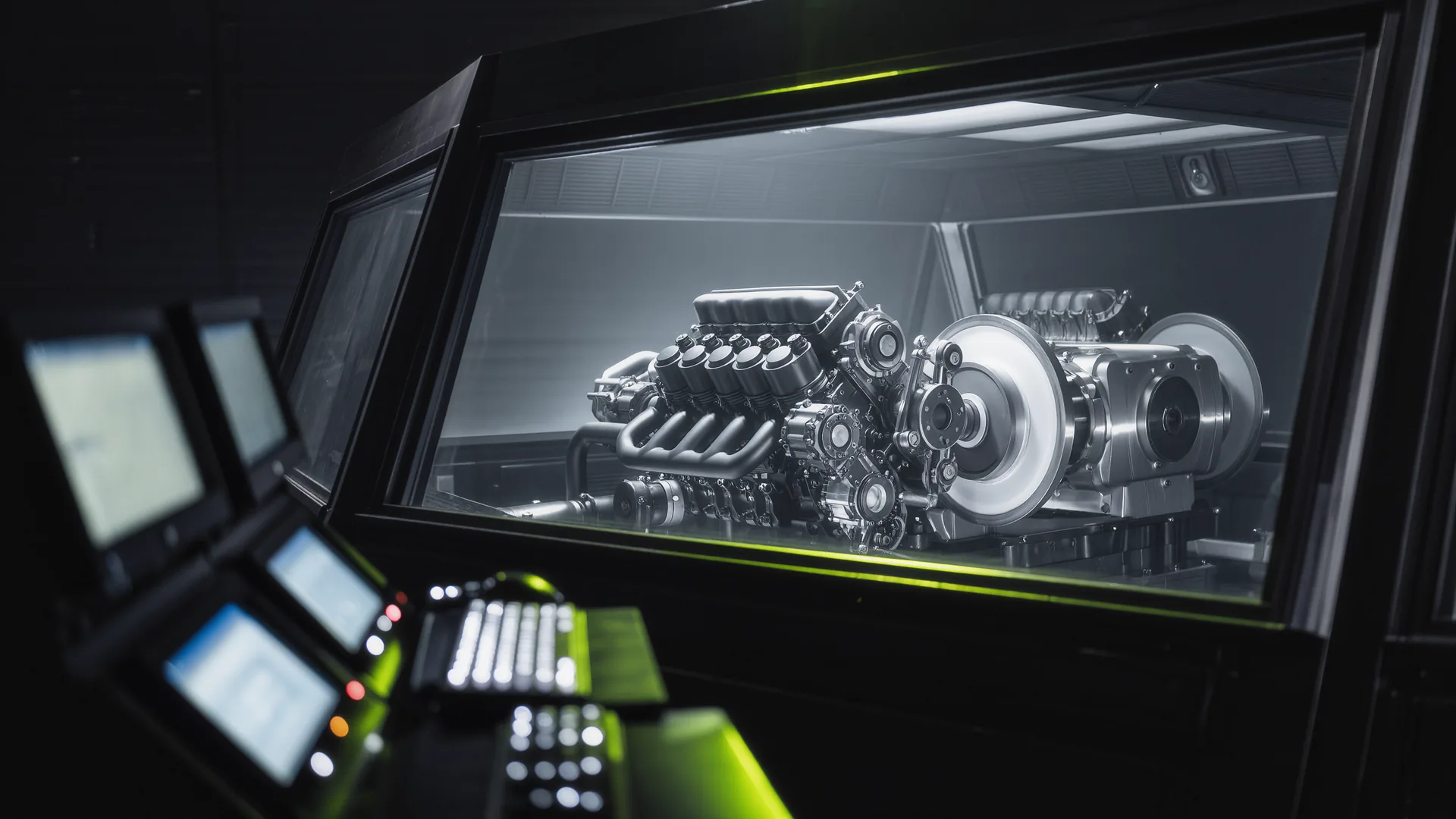
A dynamometer measures torque on a particular day in particular air, and without a correction factor it is recording the weather. Every standard therefore normalises the result to a reference atmosphere, and the references do not agree. SAE J1349 uses 99 kPa of dry air at 25 °C. DIN 70020 and UNECE Regulation 85 use 101.3 kPa at 20 °C. The denser reference returns the larger figure, and the gap is about 1.4 per cent.
Why a correction exists at all
An engine's output depends on the mass of air it can burn, and air mass depends on density. Density follows ρ = p / (R · T), so it rises with pressure and falls with temperature. Between a cold high pressure morning and a hot low pressure afternoon, the same engine can differ by 10 per cent or more with nothing changed.
A correction factor measures the actual pressure, temperature and humidity in the test cell, computes how far that air sits from the standard reference, and scales the measured result accordingly. Without it, two dynamometer runs a week apart are not comparable, and neither is a German figure against an American one.
| Standard | Reference pressure | Reference temperature | Relative figure | Where it is used |
|---|---|---|---|---|
| SAE J1349 | 99 kPa dry air | 25 °C | Lower | United States |
| DIN 70020 | 101.3 kPa dry air | 20 °C | +1.4 % | Germany, historically |
| UNECE Regulation 85 | 101.3 kPa dry air | 20 °C | +1.4 % | European type approval |
The working conversion is to divide a DIN or ECE figure by 1.0139 to reach SAE net. On a 500 PS engine that is 7 PS, which is smaller than most people assume and larger than the difference between many model variants.
The dry air detail that catches people
All three references specify dry air pressure, meaning the partial pressure of the air with water vapour excluded. Humidity displaces oxygen, because water vapour occupies volume without contributing anything combustible, so a humid day is a lower oxygen day at the same barometric reading.
A correction that uses total barometric pressure without subtracting vapour pressure will overstate the correction and therefore overstate the corrected power. This is one of the more common ways a rolling road figure ends up optimistic, and it is invisible unless the humidity input is checked.
What a correction factor cannot fix
The correction assumes output scales with air density, which is a good approximation for a naturally aspirated engine and a poor one elsewhere.
- Turbocharged engines are corrected badly. They target a boost pressure rather than accepting ambient density, so they already compensate for the weather in a way the correction then compensates for again. The correction can therefore apply a gain the engine did not lose.
- Charge temperature is not ambient temperature. An intercooler that is heat soaked after three runs presents the engine with air far warmer than the cell, and no atmospheric correction knows that.
- Fuel quality is not in the equation. An engine near its knock limit responds to octane, and the correction has no term for it.
- It cannot repair a bad measurement. Tyre slip, incorrect inertia settings and an unrealistic sweep rate all corrupt the raw figure, and correcting a corrupt figure produces a corrected corrupt figure.
Reading a power claim properly
Ask three questions. Which standard was applied, since that alone is worth 1.4 per cent. Which unit is being quoted, since PS, hp and kW differ and 500 PS is 493 hp and 368 kW. And whether the figure is at the crankshaft or the wheels, because those are different points in the drivetrain and mixing them is worth several per cent more.
A figure that answers all three is comparable to another figure that answers all three. A figure that answers none is a number without units.
Questions readers ask
What is a dyno correction factor?
A scaling applied to a measured result to normalise it to a standard reference atmosphere. It measures actual test cell pressure, temperature and humidity, works out how far that air is from the reference, and adjusts the figure so results from different days are comparable.
Why do SAE and DIN figures differ?
Because they normalise to different air. SAE J1349 uses 99 kPa of dry air at 25 °C, while DIN 70020 and UNECE Regulation 85 use 101.3 kPa at 20 °C. The second reference is denser, so it returns a figure about 1.4 per cent higher for the same engine.
How do I convert a DIN figure to SAE net?
Divide by 1.0139. On a 500 PS engine that is a difference of about 7 PS. The conversion works because the test conditions are close enough that the ratio between the two reference densities dominates.
Does humidity matter?
Yes. All three standards reference dry air pressure, so water vapour has to be subtracted from the barometric reading. Vapour displaces oxygen without contributing anything combustible, and a correction using total pressure instead of dry pressure overstates the result.
Are turbocharged engines corrected accurately?
Less so. A turbocharged engine targets manifold pressure rather than accepting ambient density, so it has already compensated for the conditions the correction is about to compensate for again. The correction can add back a loss the engine never suffered.
Sources
- Engine power correction standards, on the reference conditions of SAE J1349, DIN 70020 and ECE 85 and the 1.0139 conversion factor.
- UNECE Regulation No. 85, on net power measurement, the reference atmosphere and the correction procedure.
- Measurement of net engine power, Annex XIV, on the regulatory text governing how the measurement is conducted.
Density is calculated from ρ = p / (R · T) with R = 287.05 J/(kg·K) for dry air. Unit conversions use 1 PS = 735.5 W and 1 hp = 745.7 W.