Power and Weight
Combined Output: Why Hybrid Power Figures Do Not Add Up
An engine peaking at 7,000 rpm and a motor peaking at 3,000 never make their maxima at the same moment, so system power is always less than the sum of the two headline numbers.
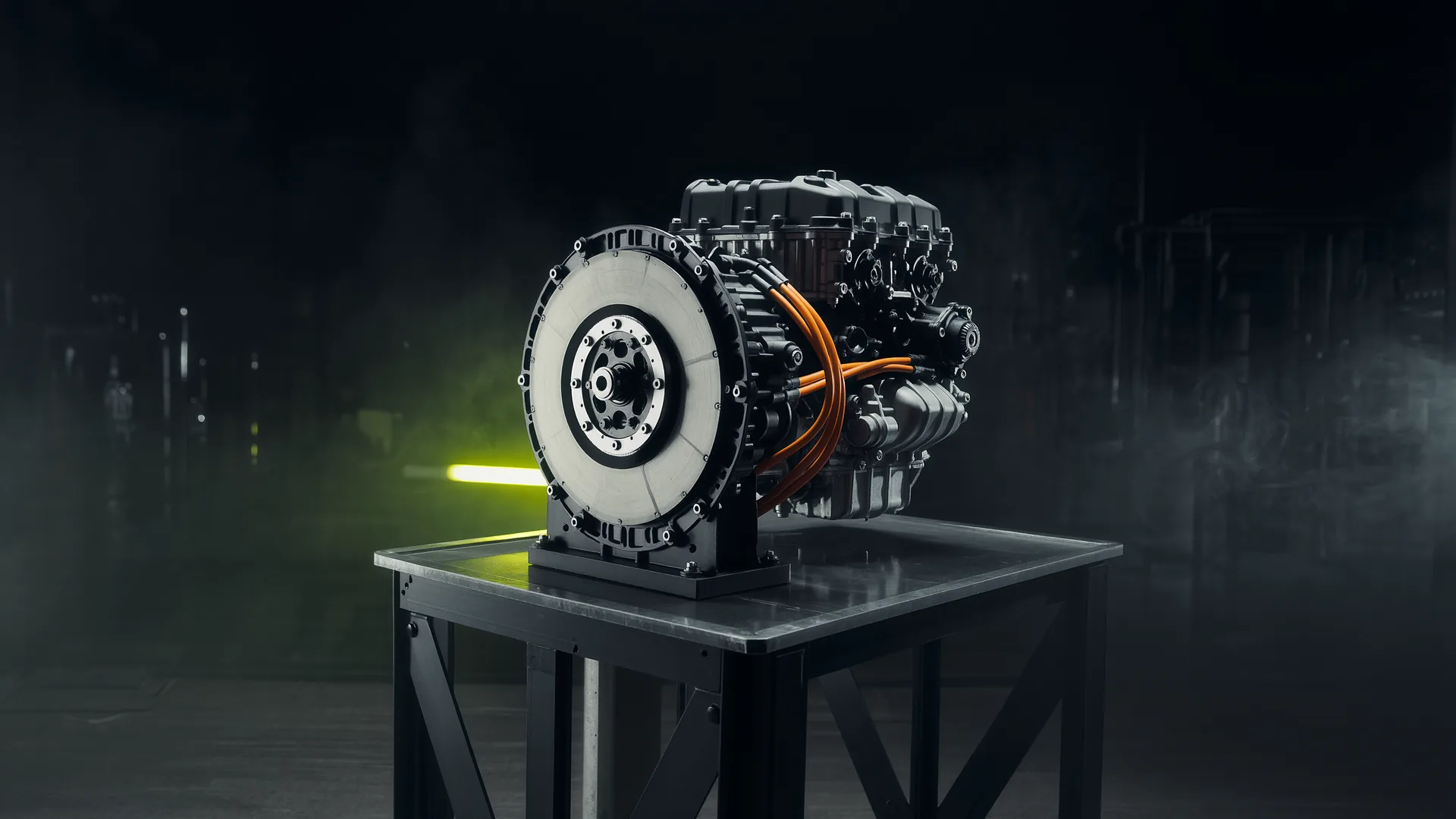
A hybrid's system power is almost never the engine figure plus the motor figure, and the reason is simple arithmetic that gets lost in the marketing. The two make their peaks at different rotational speeds, so at the moment the engine is at maximum the motor usually is not, and the other way round. On top of that the battery imposes a discharge power limit that can cap the electric contribution below the motor's own rating.
Peaks at different places
A combustion engine makes peak power near the top of its range, typically somewhere between 5,000 and 9,000 rpm, because power is torque multiplied by rotational speed and torque is roughly flat while speed keeps rising. An electric motor makes constant torque from zero up to its base speed, so its power peaks at that base speed and then flattens or falls as field weakening begins, often between 2,000 and 5,000 rpm.
| Shaft speed | Engine | Motor | Sum at that moment |
|---|---|---|---|
| 2,000 rpm | 90 kW | 100 kW | 190 kW |
| 3,500 rpm | 190 kW | 150 kW | 340 kW |
| 5,000 rpm | 290 kW | 130 kW | 420 kW |
| 6,500 rpm | 360 kW | 95 kW | 455 kW |
| 7,200 rpm | 380 kW | 70 kW | 450 kW |
| Headline peaks | 380 kW | 150 kW | 530 kW naive sum |
The true system maximum here is 455 kW, at 6,500 rpm. The naive sum of the two headline figures is 530 kW, which is 16 per cent higher than anything the powertrain can actually produce. Nobody has to be dishonest for that gap to appear, it falls out of two curves peaking in different places.
The battery limit, which can bite harder
The motor's rating describes what the motor can convert. What reaches it is limited by what the battery can discharge, and on a hybrid with a small pack that ceiling can sit well below the motor rating. A pack that can deliver a given peak for ten seconds may fall back substantially after that, so the electric contribution is time limited as well as power limited.
- State of charge matters. A pack near the bottom of its usable window delivers less power, so the same car is measurably slower with a depleted battery.
- Temperature matters. Cell internal resistance rises when cold and power is limited when hot, so full system output has a temperature window like everything else.
- Duration matters. Peak discharge is a short rating. On the second or third full throttle run the electric share can be sharply reduced, which is why a hybrid's repeat run behaviour differs from its first run.
- Plug-in hybrids have more headroom. A larger pack sustains its contribution longer, which is why their system figures are usually closer to the naive sum.
How it is supposed to be measured
Because the naive sum is meaningless, the determination of hybrid system power has been addressed at regulatory level. UNECE Regulation 85 covers the approval of internal combustion engines and electric drivetrains with regard to the measurement of net power, and separate work under the UNECE framework addresses how system power for hybrids should be determined rather than assumed.
The principle in all such methods is the same: measure the powertrain as a system, on a defined state of charge and within a defined thermal condition, rather than adding component ratings taken from separate datasheets. A published system figure that exactly equals engine plus motor is a strong indication that no such measurement was made.
What the numbers are good for
Read the three figures as answers to different questions. Engine power tells you what the car does when the battery has nothing left, which is the relevant case at the end of a long fast drive. Motor power tells you about low speed response, since electric torque arrives from zero rpm. System power, if it was measured properly, tells you about a single full throttle run from a good state of charge, which is exactly the condition an acceleration figure is quoted in.
Questions readers ask
Why is a hybrid's total power less than engine plus motor?
Because the two peak at different rotational speeds. An engine makes maximum power near the top of its range while an electric motor peaks at its base speed and falls away afterwards, so at no single moment are both at maximum. A naive sum can overstate real system power by 15 per cent or more.
Can the battery limit system power?
Yes, and on a hybrid with a small pack it often does. The motor's rating describes what it can convert, while the pack decides what reaches it. Peak discharge is a short duration rating that also falls with low state of charge and outside the cell temperature window.
Why is a hybrid slower on the second run?
Because the electric contribution is time limited. Peak battery discharge is a short rating, the pack heats up and its state of charge falls, so the same car with the same engine has less electric assistance available on a repeated full throttle run.
How should system power be measured?
As a system, on a defined state of charge and within a defined thermal condition, rather than by adding component ratings. UNECE Regulation 85 governs net power measurement for combustion engines and electric drivetrains, and further UNECE work addresses hybrid system power specifically.
Which figure should I use for comparison?
System power for a single acceleration run from a good state of charge, engine power alone for sustained hard driving with a depleted battery. They answer different questions, and a plug-in hybrid's larger pack keeps the system figure valid for longer than a small hybrid's does.
Sources
- UNECE Regulation No. 85, on the approval of internal combustion engines and electric drivetrains with regard to net power measurement.
- UNECE, determination of system power of hybrid vehicles, on why component ratings cannot simply be added and how a system measurement is approached.
- Engine power correction standards, on the reference conditions applied to the combustion side of the measurement.
The table is an illustrative parallel hybrid constructed to show curve interaction, not the specification of any particular vehicle.