Power and Weight
Kerb, Dry and DIN: Which Weight Is the Real One
European type approval defines mass in running order as the car with 90 per cent fuel and a 75 kg driver. A dry weight contains none of that and can sit 150 kg below it.
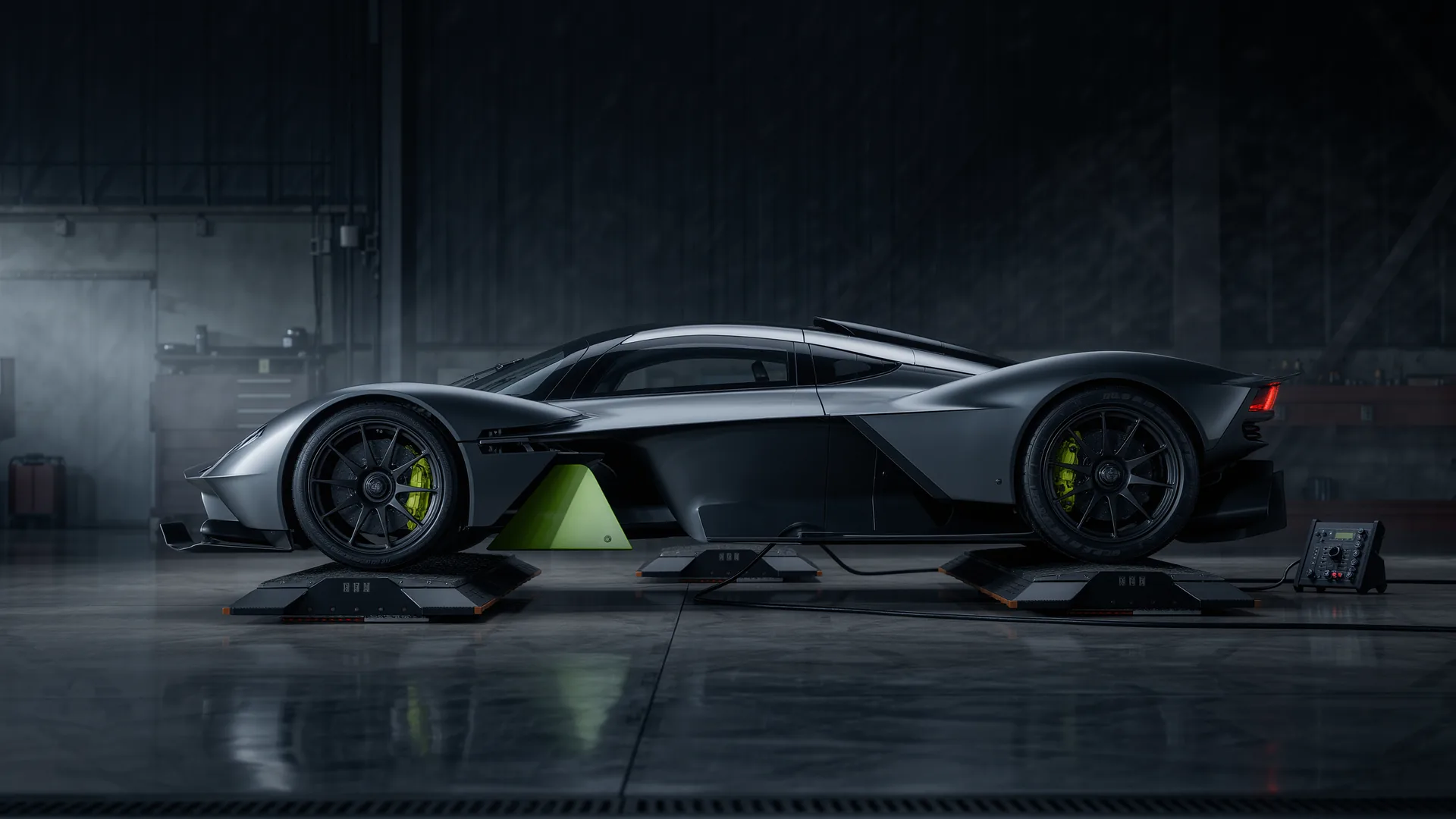
There are at least four weights for every car and only one of them is defined in law. European type approval defines mass in running order as the vehicle with its fuel tanks filled to at least 90 per cent, all liquids, standard equipment and a driver rated at 75 kg. A manufacturer's dry weight contains none of that and can sit 150 kg lower, which is enough to change a power to weight ratio by ten per cent.
The four weights, and which one is defined
| Definition | Includes | Example | Status |
|---|---|---|---|
| Dry weight | No fluids, no fuel, no driver | 1,455 kg | Manufacturer's own convention |
| Kerb weight, unladen | Fluids, small fuel load, no driver | 1,525 kg | Varies by market |
| DIN kerb weight | Fluids, 90 % fuel, no driver | 1,600 kg | German convention |
| Mass in running order | Fluids, 90 % fuel, 75 kg driver | 1,675 kg | EU type approval, defined in law |
The span from dry to running order in this example is 220 kg, which is 15 per cent of the dry figure. A car quoted at 500 PS is 344 PS per tonne against its dry weight and 299 PS per tonne against its mass in running order. Those two numbers describe the same car, and only the second one describes it as it will be driven.
What the regulation actually says
Commission Regulation (EU) No 1230/2012, since replaced by Implementing Regulation (EU) 2021/535 with the definition unchanged, defines mass in running order as the mass of the vehicle with its fuel tank or tanks filled to at least 90 per cent of capacity, including the mass of the driver, the fuel and liquids, fitted with standard equipment per the manufacturer's specification, and where fitted the bodywork, cabin, coupling, spare wheels and tools. The driver is specified as a mass rated at 75 kg located at the driver's seating reference point.
That is the only one of the four with a legal definition behind it, and it is the figure that appears on registration documents across the European Union. Everything else is a convention, and conventions differ between manufacturers and between markets.
The fuel term, which is larger than it sounds
Petrol has a density of roughly 0.745 kg per litre, so a 70 litre tank filled to 90 per cent carries about 47 kg. A 100 litre tank at 90 per cent is 67 kg. On a light sports car that is a meaningful share of the mass, and it is why a car feels different at the end of a track session and why a serious acceleration test states the fuel load.
Electric cars remove this particular ambiguity, because a battery weighs the same charged and empty, which is one of the few simplifications the transition offers. It replaces it with a different problem, since the pack itself is 500 to 800 kg on a performance car and cannot be reduced.
How to compare two cars without being caught
- Prefer mass in running order. It is defined in law, it appears on registration documents, and it is the only figure guaranteed to mean the same thing for two different cars.
- Treat dry weight as marketing. It is not wrong, it is simply a different quantity, and it is the one chosen when a small number is wanted.
- Add 75 kg to any figure that excludes the driver before comparing it with a running order figure, then add the fuel.
- Check whether options are included. Carbon brakes, lightweight seats and a roll cage all move the figure, and a press car is rarely a base specification.
- Recompute the power to weight ratio yourself. The published ratio is frequently calculated against the most flattering weight available.
Questions readers ask
What is the difference between dry weight and kerb weight?
Dry weight excludes fluids, fuel and driver. Kerb weight includes fluids and usually some fuel. Mass in running order, the EU type approval definition, includes all fluids, at least 90 per cent fuel and a driver rated at 75 kg. The span between dry and running order can exceed 200 kg.
Which weight is legally defined?
Mass in running order. Commission Regulation (EU) No 1230/2012, now Implementing Regulation (EU) 2021/535 with the definition unchanged, specifies tanks filled to at least 90 per cent, all liquids, standard equipment and a 75 kg driver at the driver's seating reference point.
How much does a full tank weigh?
Petrol is about 0.745 kg per litre, so a 70 litre tank at 90 per cent is roughly 47 kg and a 100 litre tank is about 67 kg. On a light car that is a significant share of the mass and it changes measurably over a session.
Why does the weight definition matter for power to weight?
Because the ratio changes with it. A 500 PS car at a 1,455 kg dry weight is 344 PS per tonne; the same car at its 1,675 kg mass in running order is 299 PS per tonne. That is a 15 per cent difference produced entirely by which weight was chosen.
Do electric cars avoid this problem?
They avoid the fuel ambiguity, because a battery weighs the same charged or empty. They introduce a larger fixed mass instead, since a performance EV pack is typically 500 to 800 kg and cannot be reduced by driving.
Sources
- Commission Regulation (EU) No 1230/2012, on the definition of mass in running order, the 90 per cent fuel requirement and the 75 kg driver.
- Consolidated text of Regulation 1230/2012, on the full list of items included in the definition.
- UNECE Regulation No. 85, on the power figure that forms the other half of a power to weight ratio.
Example weights are illustrative for a 1,600 kg DIN kerb weight car with a 70 litre tank. Petrol density is taken as 0.745 kg per litre.