Braking and Grip
What ABS Costs and Saves in a Panic Stop
Peak braking friction occurs at 10 to 20 per cent slip, not at a locked wheel. ABS holds the car near that peak, which is why it shortens most stops and lengthens a few.
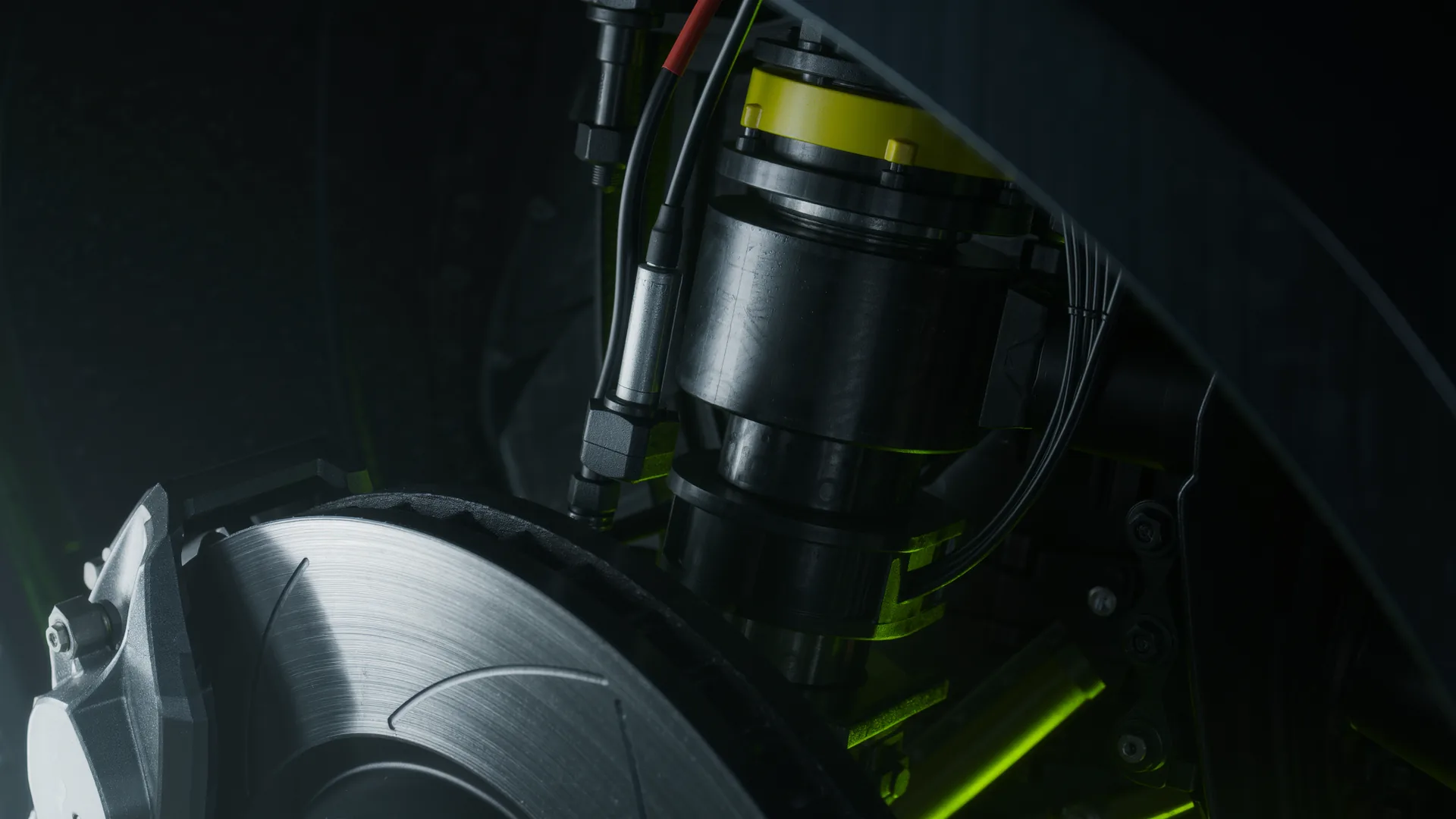
A locked wheel is not the maximum braking condition. Peak longitudinal friction occurs at roughly 10 to 20 per cent slip, and beyond that the tyre slides and friction falls. Anti-lock braking works by holding each wheel near that peak instead of past it, which is why it shortens most stops. It also preserves steering, because a locked front wheel cannot generate lateral force at all. There are surfaces where it lengthens a stop, and they are specific.
The slip curve, which decides everything
Slip ratio is the difference between the wheel's surface speed and the car's road speed, divided by road speed. At zero slip the tyre transmits no braking force because nothing is being deformed. Force rises steeply as slip increases, peaks somewhere around 10 to 20 per cent, then falls away as the contact patch transitions from gripping to sliding. A fully locked wheel sits at 100 per cent slip, well down the falling side of that curve.
| Slip ratio | Braking force | Lateral force available | State |
|---|---|---|---|
| 0 % | None | Full | Rolling freely |
| 5 % | Rising | High | Braking, steerable |
| 10 to 20 % | Peak | Reduced | Maximum braking |
| 40 % | Falling | Low | Sliding, poor control |
| 100 % | Well below peak | None | Locked, no steering at all |
The lateral column is the safety argument and it is more important than the distance argument. A locked front wheel produces no cornering force whatever, so the car travels in a straight line regardless of steering input. Everything a driver could do to avoid the obstacle is unavailable at exactly the moment they need it.
What the system is actually doing
Wheel speed sensors report each wheel, and when one decelerates far faster than the car's speed implies it should, the controller reduces hydraulic pressure to that wheel until it recovers, then raises it again. Modern systems cycle many times per second and act per wheel, so a car with two wheels on ice and two on asphalt brakes each pair at its own limit.
Cycling is why the pedal pulses under the foot: that is pressure being released and reapplied, and it is the system working rather than a fault. The correct response is to keep full pressure on the pedal and steer, which is the opposite of what an untrained driver instinctively does.
Where it genuinely costs distance
On loose surfaces, a locked wheel builds a wedge of material in front of it, and that wedge adds retardation the friction model does not capture. The system prevents the wedge from forming.
- Gravel and deep snow. A locked wheel ploughs and piles material ahead of itself, which can stop the car in less distance than a rolling wheel does. Some systems detect these surfaces and permit more slip in response.
- Very low friction with an obstacle ahead. On sheet ice the distance difference is small either way, and the steering that the system preserves is worth more than either.
- Severely uneven surfaces. A wheel that leaves the ground decelerates rapidly and looks like a lock, so the system may release pressure unnecessarily. Lower unsprung mass reduces this by keeping the tyre in contact.
In every one of these cases, the trade is distance against steering, and the regulations resolve it in favour of steering. That is a deliberate choice: a car that stops slightly later but can be aimed is safer than one that stops slightly sooner in whichever direction it was already pointing.
What the law requires of the whole system
UN Regulation 13-H sets service braking requirements for category M1 vehicles, including a mean fully developed deceleration of at least 5.8 m/s² in a Type-0 test from 100 km/h with the engine disconnected on a high adhesion surface, roughly 67 m. It also contains requirements for anti-lock performance, including behaviour on surfaces with different friction under the left and right wheels.
A performance car braking at 1.2 g, which is 11.77 m/s², is achieving more than double the regulatory minimum, and it is doing so through the tyre rather than through the electronics. The system's job is to let the tyre reach its own limit, not to exceed it.
Questions readers ask
Does ABS lengthen or shorten braking distance?
It shortens most stops, because peak braking friction occurs at about 10 to 20 per cent slip and a locked wheel sits at 100 per cent, well down the falling side of the curve. It can lengthen a stop on gravel or deep snow, where a locked wheel builds a wedge of material ahead of it.
Why is a locked wheel worse?
Two reasons. It produces less braking force than a wheel held near peak slip, and it produces no lateral force at all, so the car cannot be steered. The second reason matters more than the first in an emergency.
Why does the pedal pulse?
Because the system is releasing and reapplying hydraulic pressure many times per second to hold each wheel near its peak slip. It is the system working. The correct response is to keep full pressure on the pedal and steer.
Should I pump the brakes instead?
No. A human cannot modulate anywhere near the frequency the system does, and pumping removes pressure at moments the system would have kept it. Full continuous pressure lets the controller do its job on all four wheels independently.
What does the regulation require?
UN Regulation 13-H requires at least 5.8 m/s² mean fully developed deceleration for category M1 vehicles from 100 km/h with the engine disconnected on a high adhesion surface, about 67 m, alongside anti-lock performance requirements including surfaces with different friction left and right.
Sources
- UN Regulation No. 13-H, on service braking and anti-lock requirements for category M1 vehicles.
- Vehicle Physics Pro, tyre model documentation, on the slip ratio curve and the location of peak longitudinal force.
- Tire friction overview, on the interaction between longitudinal and lateral force as slip increases.