Braking and Grip
Brake Fade: The Two Different Failures
Pad fade shortens the stop and gives warning. Fluid fade lengthens the pedal and gives none. They have different causes, different symptoms and different fixes.
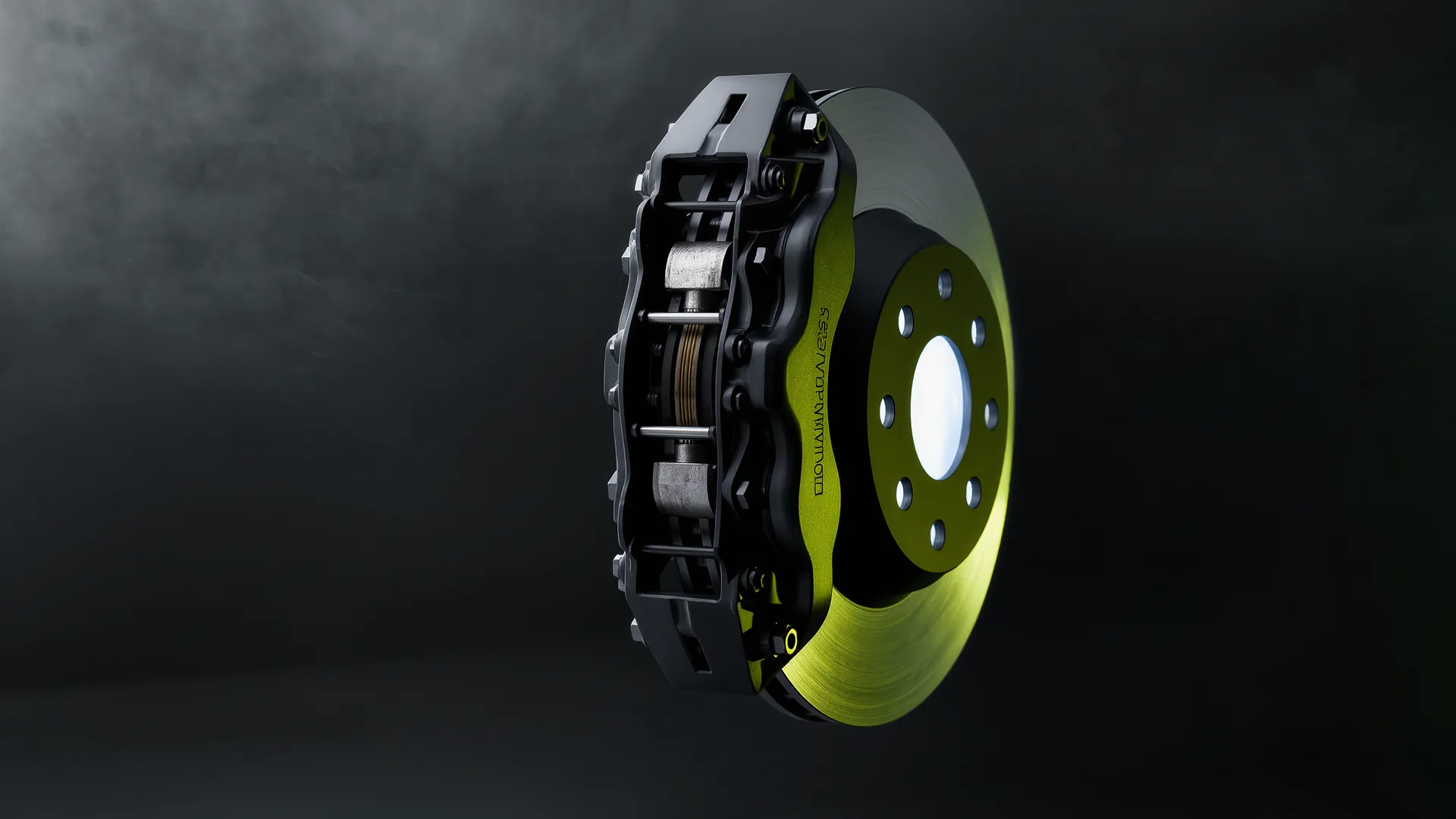
Brake fade is two unrelated failures with one name, and confusing them leads people to fix the wrong thing. Pad fade is a loss of friction as the pad overheats: the pedal stays firm and the car stops less well. Fluid fade is vapour forming in overheated brake fluid: the pedal goes long or to the floor. The first gives warning. The second does not, and it is the dangerous one.
Telling them apart
| Pad fade | Fluid fade | |
|---|---|---|
| Cause | Friction material above its working temperature | Vapour bubbles in overheated fluid |
| Pedal feel | Normal, firm | Long, soft, can reach the floor |
| Deceleration | Reduced, progressively | Sharply reduced or absent |
| Warning | Yes, it degrades over several stops | Little or none |
| Recovery | Returns as the pad cools | Returns as fluid cools, but the fluid is now suspect |
| Fix | Higher temperature pad compound | Fresh high boiling point fluid, better cooling |
A firm pedal that will not stop the car is a friction problem. A pedal that travels further than it should is a hydraulic problem. That single distinction identifies which failure is happening while it is happening.
Why heat arrives so fast
Braking converts kinetic energy into heat, and kinetic energy scales with the square of speed. A stop from 300 km/h dissipates 9 times the energy of a stop from 100 km/h, and it does so in roughly three times the duration, so the rate of heat generation is around three times higher as well.
Mass compounds it. On the same stop, energy is proportional to weight, so a 2,200 kg car puts 37 per cent more heat into its brakes than a 1,600 kg car. That is why heavy fast cars fade sooner than their brake specification suggests, and why an electric car with a large battery has a thermal problem its acceleration figures do not hint at.
The fluid problem, which is about water
Brake fluid is hygroscopic, meaning it absorbs moisture from the atmosphere through seals and hoses over time. Water lowers the boiling point substantially, so a fluid that met a high specification when new can be well below it after two or three years in service.
Manufacturers therefore quote two boiling points: a dry figure for fresh fluid and a wet figure for fluid that has absorbed a defined amount of water. The wet figure is the one that describes the car most of the time, and it is the number to compare when choosing fluid for hard use. Regular replacement is the only fix, because the water cannot be removed from the fluid in place.
What actually prevents both
- Let the brakes cool between hard stops. Both failures are cumulative. A cooling lap does more than any component change.
- Do not hold the pedal at rest after a hard session. A stationary car with hot pads clamped on a disc concentrates heat in one spot, which can distort the disc and imprint pad material.
- Match the pad to the use. A high temperature compound is worse when cold, which is a real safety trade-off on a road car that mostly makes gentle stops.
- Replace fluid on schedule. Compare the wet boiling point, not the dry one, since that is the condition the fluid spends most of its life in.
- Improve cooling before adding capacity. Ducting air to the discs addresses the cause. A larger disc adds thermal mass, which delays the problem rather than removing it.
What the regulation already tests
Fade resistance is not left to the manufacturer's judgement. UN Regulation 13-H includes heated performance requirements alongside the cold Type-0 test, so a type approved car has to demonstrate that its braking survives repeated application rather than only performing once. The baseline requirement is a mean fully developed deceleration of at least 5.8 m/s² from 100 km/h, roughly 67 m.
A car that fades on a circuit is therefore not failing a standard, it is being used well outside the duty cycle the standard describes. That is a reasonable design decision by the manufacturer and a poor assumption by the driver.
Questions readers ask
What is the difference between pad fade and fluid fade?
Pad fade is a loss of friction as the pad exceeds its working temperature: the pedal stays firm and the car stops less well. Fluid fade is vapour forming in overheated brake fluid: the pedal travels long or reaches the floor. The pedal feel identifies which is happening.
Which one is more dangerous?
Fluid fade, because it gives little warning and can remove braking almost entirely, while pad fade degrades progressively over several stops. Pad fade tells you to stop pushing. Fluid fade tells you nothing until the pedal goes.
Why does brake fluid need replacing?
Because it absorbs moisture from the atmosphere through seals and hoses, and water lowers the boiling point substantially. Manufacturers quote a dry boiling point for fresh fluid and a wet one for fluid that has absorbed water. The wet figure describes the car most of the time.
Do bigger brakes prevent fade?
They delay it rather than prevent it, by adding thermal mass. Cooling addresses the cause: ducting air to the discs removes heat continuously, while a larger disc only stores more of it before the temperature rises.
Why do heavy cars fade sooner?
Because energy dissipated in a stop is proportional to mass. A 2,200 kg car puts 37 per cent more heat into its brakes than a 1,600 kg car on the same stop, and heat is what causes both failures.
Sources
- UN Regulation No. 13-H, on service braking requirements including heated performance tests and the Type-0 baseline.
- Autosport technical forum, tyre coefficient of friction, on the tyre limit that a healthy brake system is working against.
- Regulation (EU) 2020/740, Annex I, on the wet grip classification, the other half of braking performance.
Energy comparisons use kinetic energy proportional to the square of speed and to mass. The 37 per cent figure is the ratio of 2,200 kg to 1,600 kg.