Braking and Grip
Carbon Ceramic vs Steel: What You Actually Buy
Carbon ceramic discs do not shorten a first stop, because tyres set that. What you buy is unsprung weight, fade resistance and a service life measured in tens of thousands of kilometres.
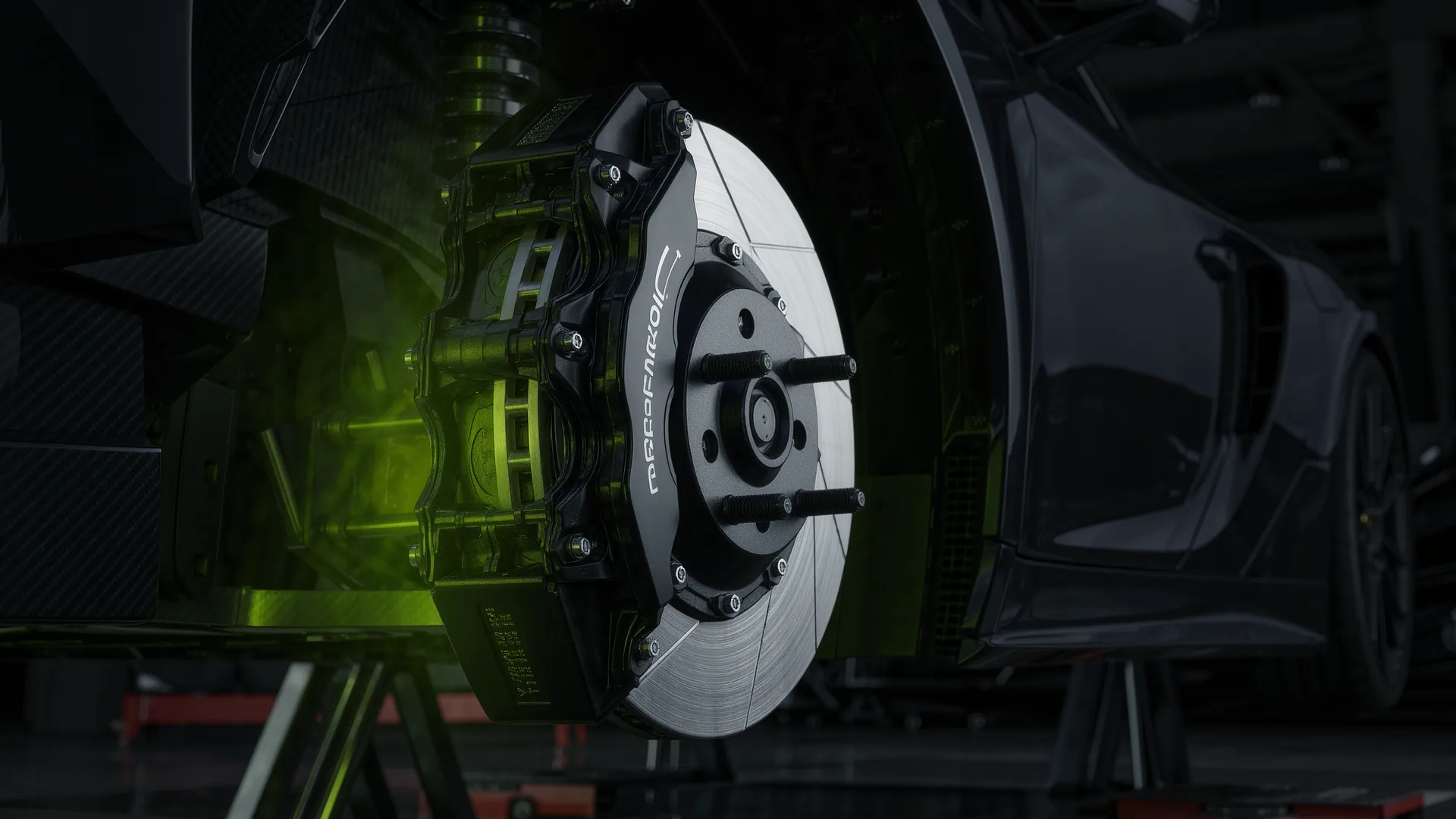
Carbon ceramic brakes do not stop a car more quickly on a first application from moderate speed, and anybody selling them on that basis is selling the wrong thing. A first stop is limited by the tyres, and a good steel system already exceeds what a road tyre can transmit. What the ceramic disc genuinely delivers is unsprung weight, thermal stability across repeated stops and a service life that can outlast several sets of steel discs.
Why the first stop is identical
Deceleration at the limit is the tyre friction coefficient multiplied by gravity. Road tyres run from 0.7 to 1.0, so a car braking at 1.0 g is already at the ceiling of a good one, and any brake system capable of reaching that ceiling produces the same stopping distance as any other. A steel system on a modern performance car reaches it comfortably.
The consequence is that a published 100 to 0 km/h figure is largely a tyre test, and swapping discs will not move it. Where the two systems diverge is the second stop, the fifth stop and the stop from 250 km/h.
What you are actually buying
| Property | Steel | Carbon ceramic | Matters when |
|---|---|---|---|
| First stop distance | At the tyre limit | At the tyre limit | Never, they are equal |
| Disc mass | Reference | Substantially lower | Always, it is unsprung |
| Fade under repeated stops | Degrades | Very stable | Track use, mountain descents |
| Cold bite | Good immediately | Needs some temperature | First stop on a cold morning |
| Wear and service life | Consumable | Very long | Over the life of the car |
| Brake dust and corrosion | Both present | Minimal | Everyday ownership |
| Replacement cost | Modest | High | If a disc is ever damaged |
The weight argument is the strongest one
A brake disc sits outboard of the suspension and rotates, so it is penalised twice. Its rotational inertia gives it an effective mass factor of roughly 1.5, meaning a kilogram saved there is worth about a kilogram and a half in acceleration and braking terms. And because it is unsprung, reducing it improves the suspension's ability to keep the tyre in contact with an uneven surface, which affects grip, braking and steering precision together.
That second benefit is not measurable on a specification sheet and is the one owners tend to notice. It is also why the weight saving matters on a road car that will never see a circuit, whereas the fade resistance largely does not.
Where fade resistance earns its money
Braking converts kinetic energy into heat, and energy scales with the square of speed. A stop from 300 km/h dissipates 9 times the energy of a stop from 100 km/h, delivered in a fraction of the time. On a circuit, repeated stops arrive faster than the system can shed heat, and disc temperature climbs across the session.
Steel loses friction coefficient and stiffness as it heats, and the pads and fluid have their own limits. A carbon ceramic disc holds its friction characteristics across a far wider temperature band, so the pedal feel and the deceleration available on the tenth stop resemble the first. That is the property being paid for, and on a car that never does ten hard stops in succession it is never collected.
The honest disadvantage
Carbon ceramic systems need some temperature to reach full bite, so the very first application on a cold morning can feel less immediate than steel. Manufacturers compensate with pad compounds designed for a wider window, and the effect is mild on modern systems, but it is the direct reverse of the fade advantage and it exists for the same reason.
The other disadvantage is money. A damaged ceramic disc is a large invoice, and unlike steel it is not a routine consumable that gets replaced as a matter of course. That is a genuine argument for steel on a car that is used hard on ordinary roads.
Questions readers ask
Do carbon ceramic brakes shorten stopping distance?
Not on a first stop. Deceleration is limited by tyre friction, which runs from 0.7 to 1.0 for road tyres, and a good steel system already reaches that ceiling. The difference appears on repeated stops and from very high speed, where thermal capacity becomes the constraint.
What is the main benefit then?
Unsprung and rotating weight, plus fade resistance. A disc has an effective mass factor of about 1.5, so weight saved there counts one and a half times, and reducing unsprung mass helps the suspension keep the tyre on the road. That benefit applies on every journey.
Are they worth it for road use?
The weight saving and the service life are collected on the road. The fade resistance is not, unless the car does repeated hard stops. Against that sits a high replacement cost if a disc is damaged, which is a real argument for steel on a hard used road car.
Why do they feel weak when cold?
Because the friction material needs some temperature to reach full bite. It is the same property that gives the system its fade resistance, seen from the other end. Modern pad compounds reduce the effect considerably.
How much heat does a hard stop generate?
Enough that speed dominates everything. Energy scales with the square of speed, so a stop from 300 km/h dissipates nine times the energy of one from 100 km/h. On a circuit those stops arrive faster than the system can shed the heat, which is what causes fade.
Sources
- Autosport technical forum, tyre coefficient of friction, on the friction values that set the first stop limit.
- UN Regulation No. 13-H, on service braking requirements and the fade tests a system must survive.
- Vehicle Physics Pro, tyre model documentation, on how unsprung mass and fluctuating vertical load affect available grip.
The effective mass factor for a disc is 1 + I / (m r²) using a representative disc moment of inertia. Energy comparisons use kinetic energy proportional to the square of speed.