Braking and Grip
Braking With Downforce: Stopping Harder Than 1 g
Downforce adds vertical load without adding mass, which is the only way to exceed the tyre's own friction limit. At 300 km/h it can raise available deceleration by 60 per cent.
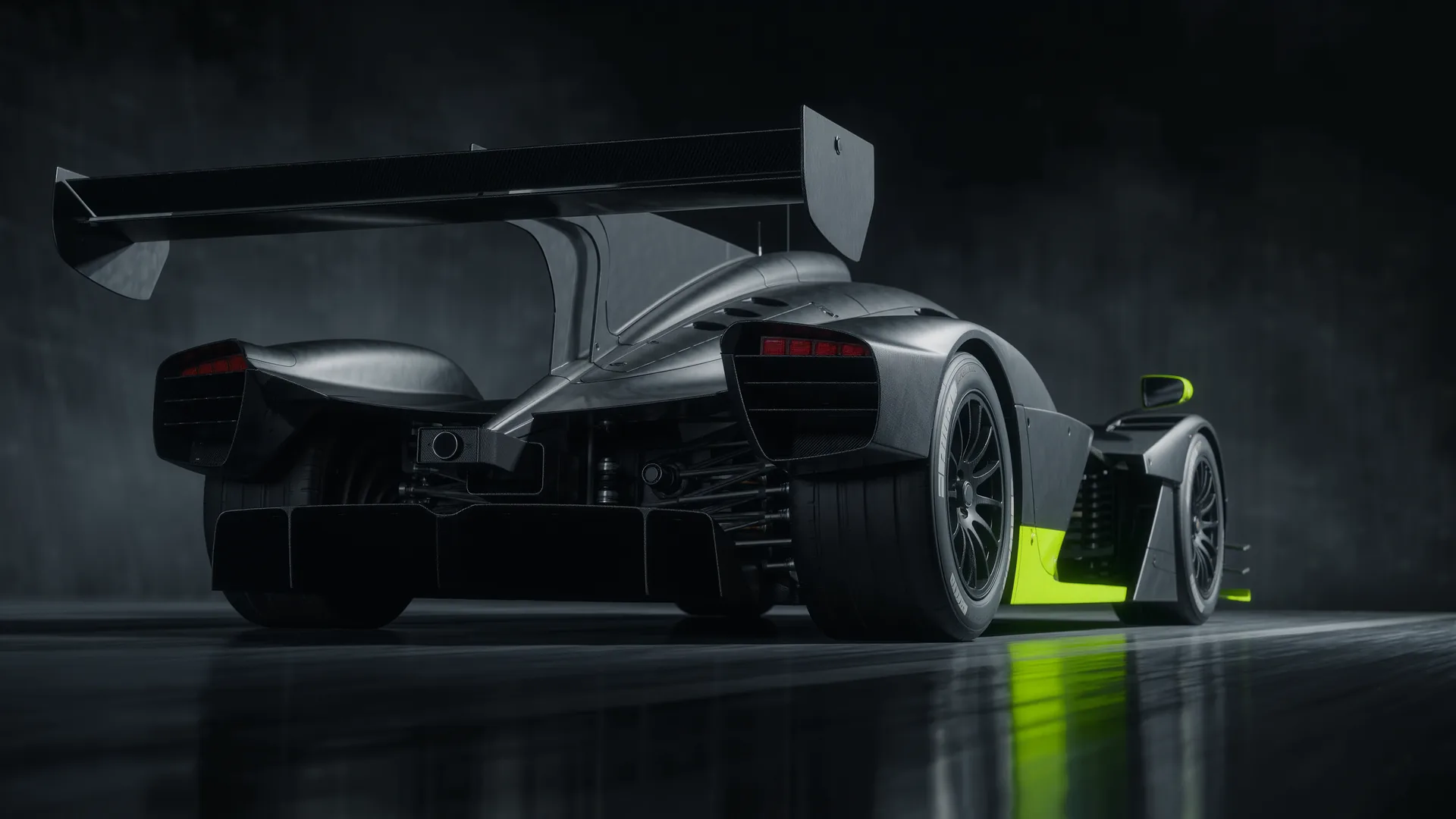
Tyre friction sets a ceiling on deceleration at μg, and no brake system beats it. Downforce is the one thing that does, because it adds vertical load without adding mass. A package producing 900 kg at 300 km/h on a 1,500 kg car raises the normal force by 60 per cent while the mass to be stopped is unchanged, so available deceleration rises by the same proportion. It is also why a fast car brakes hardest at the start of a stop and progressively less as it slows.
Why it works when mass does not
Deceleration at the friction limit is the friction coefficient multiplied by the normal force, divided by the mass. Adding mass raises both the numerator and the denominator, so it cancels and deceleration is unchanged. Adding downforce raises the normal force alone, so it does not cancel:
a = μ · (mg + L) / m
where L is the aerodynamic load. That is the only lever available for exceeding μg, and it explains why racing cars decelerate at values road cars cannot approach.
| Speed | Downforce | Normal force added | Deceleration | In g |
|---|---|---|---|---|
| 100 km/h | 100 kg | +6.7 % | 14.65 m/s² | 1.49 g |
| 150 km/h | 225 kg | +15.0 % | 15.79 m/s² | 1.61 g |
| 200 km/h | 400 kg | +26.7 % | 17.40 m/s² | 1.77 g |
| 250 km/h | 625 kg | +41.7 % | 19.46 m/s² | 1.98 g |
| 300 km/h | 900 kg | +60.0 % | 21.97 m/s² | 2.24 g |
The advantage disappears as you slow
Downforce scales with the square of speed, so it collapses through the stop. Halving speed leaves a quarter of the load. A car that begins braking at 2.24 g at 300 km/h is down to 1.77 g by 200 km/h and 1.49 g by 100 km/h, approaching the tyre's own limit as it arrives at the corner.
This is why braking technique in a downforce car is the reverse of the road car instinct. The correct approach is maximum pedal pressure at the start, when the aerodynamic load supports it, then progressively releasing pressure as speed falls, because the available grip is falling with it. Holding constant pressure locks the wheels near the end of the stop.
What it is worth in distance
Stopping distance is v² / (2a), and with downforce the deceleration is not constant, so the simple formula understates the benefit. Taking the two extremes for a stop from 300 km/h on the car above: at a constant 1.4 g, 252.8 m. At a constant 2.24 g, 158.0 m. The real answer lies between them and nearer the second, because the highest deceleration is available at the start where the most speed has to be shed.
The practical consequence is that the braking advantage of an aerodynamic car is largest exactly where it is most valuable, at the end of a straight, and negligible in a slow corner sequence where the same car is carrying the drag penalty with nothing in return.
The air brake, which is a separate effect
A wing pushed far past its useful angle stops being an efficient downforce device and becomes a deliberate drag device. That drag acts directly as a retarding force, adding deceleration without involving the tyres at all, and it does so hardest at high speed where the tyres need the most help.
It has a second benefit that is easy to miss. A raised rear wing loads the rear axle at the moment braking is transferring weight forward and unloading it, which improves stability under braking rather than only shortening the stop.
Questions readers ask
How does downforce shorten braking distances?
By adding vertical load without adding mass. Deceleration at the limit is μ times normal force divided by mass, so extra weight cancels out while aerodynamic load does not. On a 1,500 kg car, 900 kg of downforce raises the normal force by 60 per cent and deceleration with it.
Why does braking get harder as the car slows?
Because downforce scales with the square of speed, so it falls to a quarter when speed halves. A car braking at 2.24 g at 300 km/h is at 1.49 g by 100 km/h, which is why pedal pressure has to be released progressively rather than held constant.
Can a road car exceed 1 g braking?
Yes, on tyre friction alone if the compound is good enough, since track focused tyres exceed a coefficient of 1.2. Going substantially beyond that requires downforce, because the tyre's own coefficient is the only other term in the equation.
Why does adding weight not help braking?
Because it raises the normal force and the mass to be stopped in the same proportion, so it cancels out of a = μ(mg + L)/m. Only downforce adds one without the other, which is why it is the single lever for exceeding μg.
What does an air brake add?
Drag acting directly as a retarding force, without involving the tyres, and strongest at high speed where it is most needed. A raised rear wing also loads the rear axle at the moment braking is transferring weight off it, which helps stability as well as distance.
Sources
- Autosport technical forum, tyre coefficient of friction, on the friction values that set the baseline deceleration.
- Vehicle Physics Pro, tyre model documentation, on how added vertical load translates into available force.
- UN Regulation No. 13-H, on the service braking requirements a road car must meet without any aerodynamic assistance.
Figures assume a 1,500 kg car at a friction coefficient of 1.4 with a package producing 100 kg of downforce at 100 km/h, scaling with the square of speed. Grip is treated as proportional to load, which slightly overstates the benefit because friction falls as load rises.