Braking and Grip
The Contact Patch: Why Wider Tyres Still Grip More
Classical friction says area does not matter. Tyres disobey it because friction falls as load rises, so spreading the same weight over more rubber returns more total grip.
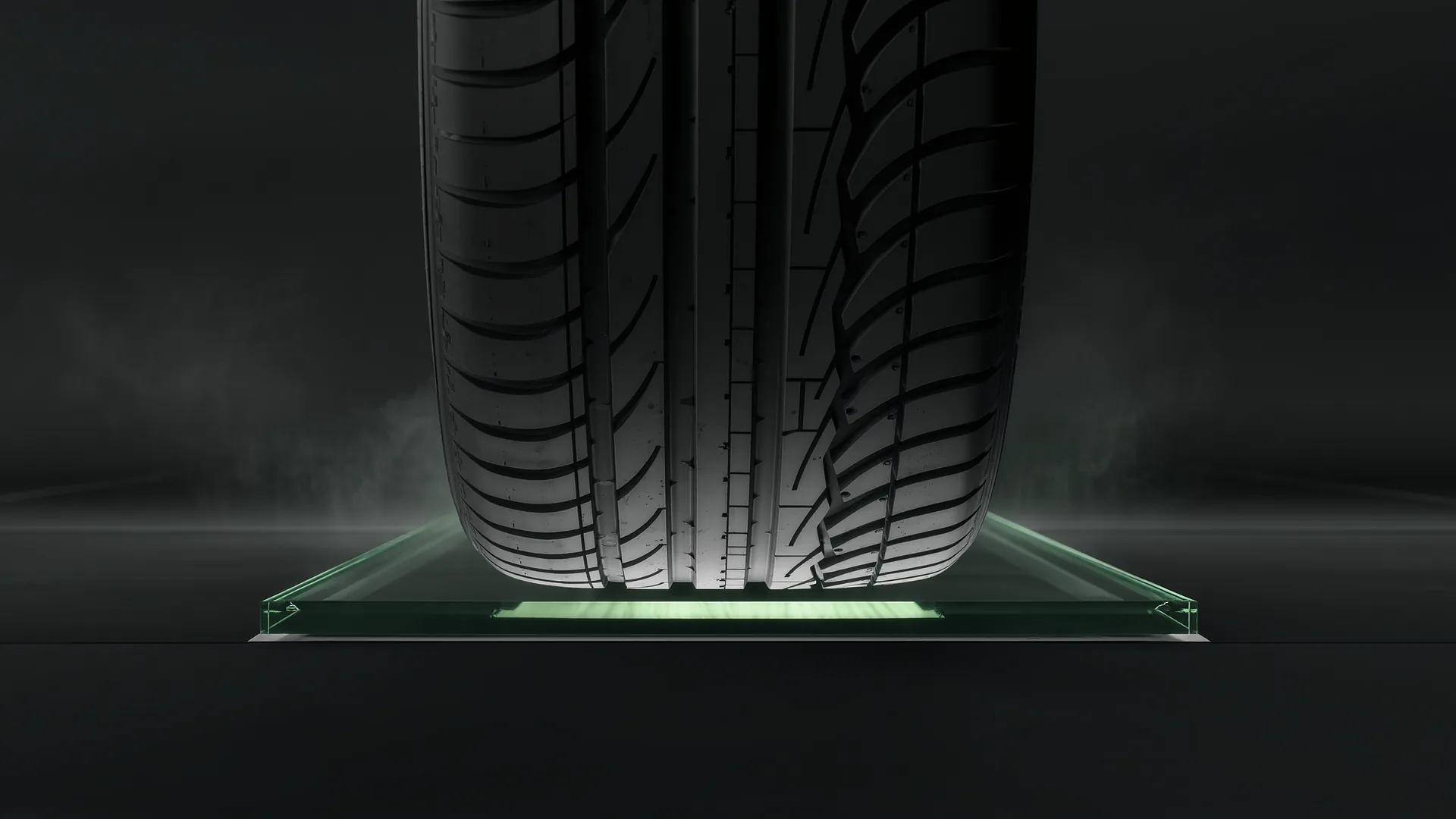
Classical friction theory says the force a surface can transmit depends on load and material, and not on contact area. Tyres appear to break that rule, and they do not: they exploit a second effect the classical model ignores. The friction coefficient of a tyre falls as vertical load rises. Spreading the same weight across a larger contact patch means each part of it works at a lower load and therefore at a higher coefficient, so the total is greater.
What the classical model gets right
Coulomb friction states that the maximum tangential force is the coefficient of friction multiplied by the normal load, with no area term. For two rigid bodies pressed together this is an excellent approximation, and it is why the model has survived. Contact area does not appear because increasing it reduces pressure in exact proportion, so the two cancel.
What it assumes is that the coefficient of friction is a constant. For a rubber tyre it is not, and that single assumption is where the model parts company with reality.
Load sensitivity, the effect that matters
A tyre's coefficient of friction decreases as vertical load increases. This is why, when a car corners hard and transfers load to the outer tyres, the grip of those tyres does not increase in proportion to the extra weight they are carrying. It is one of the central facts of vehicle dynamics and it explains a long list of otherwise confusing behaviour.
| Setup | Load per unit of contact area | Effective friction coefficient | Total force available |
|---|---|---|---|
| Narrow tyre | High | Lower | Reference |
| Wide tyre, same load | Lower | Higher | Greater |
| Wide tyre, doubled load | Back to high | Back to lower | Less than double |
The third row is the same effect seen from the other direction, and it is the reason a heavy car cannot simply fit wider tyres and behave like a light one. Adding mass raises the load per unit area again, which brings the coefficient back down.
Putting numbers on it
Take a tyre whose coefficient falls linearly from 1.30 at 4,000 N to 1.15 at 6,000 N, a drop of about 12 per cent for a 50 per cent load increase. Those values are illustrative, but the slope is representative. Now compare an evenly loaded axle against the same axle after weight transfer.
| Case | Inner tyre | Outer tyre | Total lateral force | Against even loading |
|---|---|---|---|---|
| Even, 5,000 N each | 5,000 N at μ 1.225 | 5,000 N at μ 1.225 | 12,250 N | reference |
| Transferred, 3,000 and 7,000 N | 3,000 N at μ 1.375 | 7,000 N at μ 1.075 | 11,650 N | −600 N, −4.9 % |
The axle carries exactly the same 10,000 N in both cases and produces 4.9 per cent less cornering force after transfer. Nothing about the tyres changed. That is load sensitivity, and it is the entire reason a lower centre of gravity and a wider track make a car faster.
The contact patch itself is smaller than most people picture. Area is approximately load divided by inflation pressure, so a 1,600 kg car at 2.5 bar carries about 3,924 N per tyre over roughly 157 cm², a patch a little larger than a postcard. Four of those, about 628 cm² in total, are the entire connection between the car and the road.
What load sensitivity explains
- Why weight transfer costs grip. A pair of tyres, one heavily loaded and one lightly loaded, produces less total force than the same pair loaded evenly, because the heavily loaded one is operating at a reduced coefficient. Reducing weight transfer is therefore worth grip on its own.
- Why anti-roll bars tune balance. A stiffer bar at one end forces more load transfer across that axle, reducing its grip relative to the other. That is the whole mechanism, and it works purely through load sensitivity.
- Why low weight helps more than it should. A lighter car works its tyres at lower load, so it gets a higher coefficient as well as needing less force. The benefit is compounded rather than proportional.
- Why unsprung mass matters. A tyre whose vertical load fluctuates over a bumpy surface spends time both above and below its mean load, and because the relationship is not linear, the average available grip is lower than the grip at the mean load.
Shape, not just size
The contact patch of a modern performance tyre is short and wide rather than long and narrow, and that is a deliberate choice rather than a consequence of the tyre being wide. A short patch means each element of tread spends less time in contact per revolution, which reduces heat build-up, and a wide patch resists lateral force with less distortion at the edges.
Aspect ratio is the lever. A lower profile sidewall distorts less under lateral load, so more of the steering input reaches the contact patch rather than being absorbed. That is why performance cars run low profiles, and also why they ride badly: the same stiffness that preserves steering precision transmits road inputs the sidewall would otherwise have absorbed.
Questions readers ask
If contact area does not affect friction, why are wide tyres faster?
Because a tyre's coefficient of friction falls as vertical load rises, an effect classical friction theory omits. A wider patch carries the same weight at lower load per unit area, so each part works at a higher coefficient and the total force is greater.
What is load sensitivity?
The property that a tyre's friction coefficient decreases as the vertical load on it increases. It is why the outer tyres in a corner do not gain grip in proportion to the extra weight they carry, and it underlies most of vehicle dynamics.
Why does weight transfer cost grip?
Because an unevenly loaded pair of tyres produces less total force than an evenly loaded pair carrying the same weight. The heavily loaded tyre operates at a reduced coefficient, and the lightly loaded one cannot make up the difference.
How do anti-roll bars change handling?
By forcing more load transfer across one axle than the other. The axle with the stiffer bar carries a more uneven load distribution, which reduces its grip relative to the other end. The entire mechanism works through load sensitivity.
Can I just fit wider tyres to a heavy car?
It helps, but not enough to erase the mass. Adding weight raises the load per unit of contact area again, which brings the coefficient back down. A wider tyre reduces the penalty rather than removing it.
Sources
- Autosport technical forum, tyre coefficient of friction, on load sensitivity and why grip does not rise in proportion when load transfers.
- Tire friction overview, on the friction mechanisms in rubber and how they differ from the classical model.
- Vehicle Physics Pro, tyre model documentation, on the empirical tyre model and how load enters it.