Electric Performance
Electric vs Combustion on a Lap: Where Each Wins
An EV wins every corner exit and loses every braking zone to heat. Over a 20.832 km lap the deciding factor is not peak power, it is whether the pack holds its window for the whole lap.
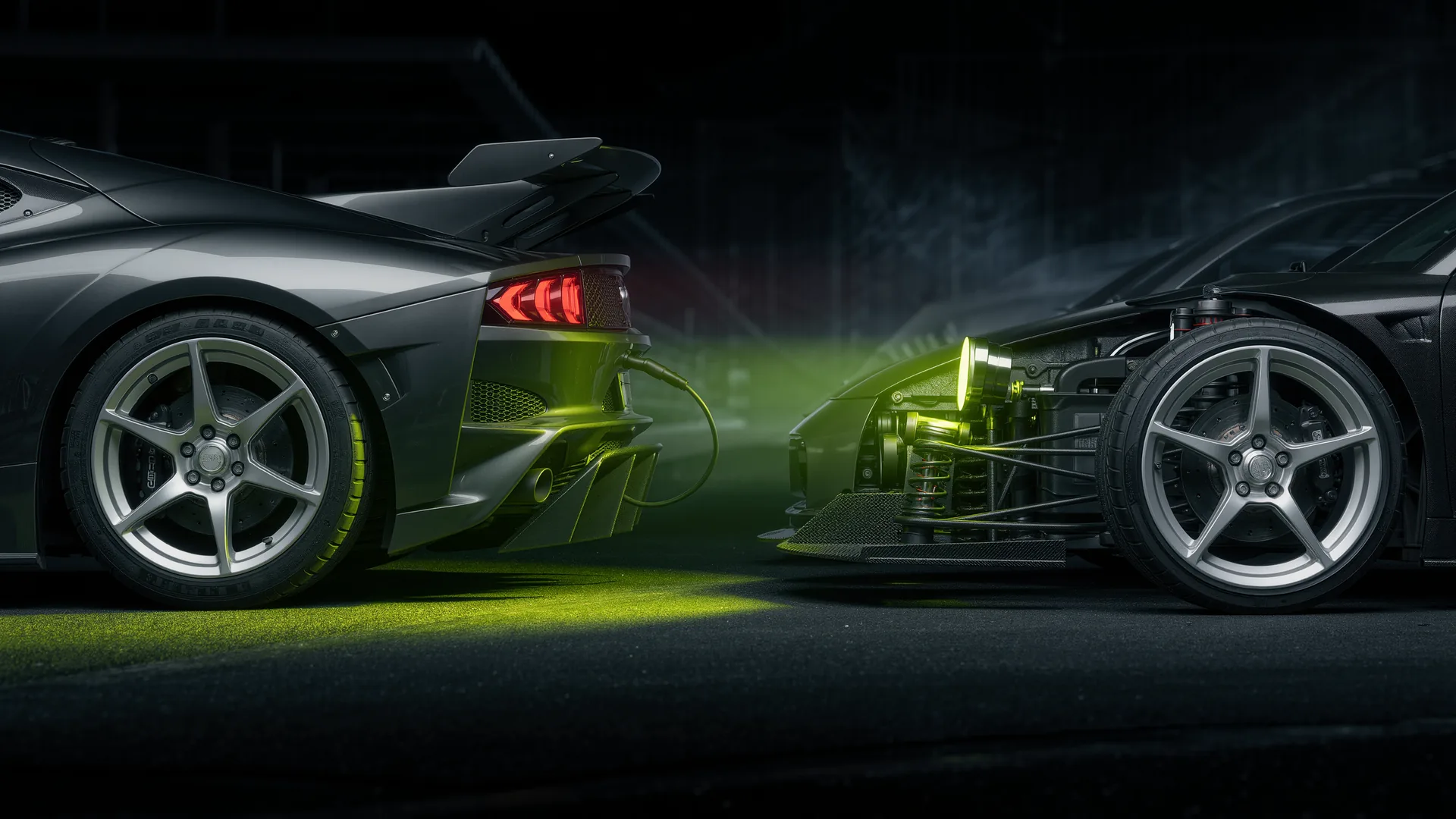
Around a circuit, the electric car and the combustion car are strong in different places and the lap adds them up. The EV wins corner exits, because torque arrives instantly and can be metered per axle in milliseconds. The combustion car wins on mass, which decides braking heat, tyre temperature and cornering load. Over a lap as long as the Nordschleife's 20.832 km, the question that decides it is whether the battery holds its temperature window from start to finish.
Sector by sector
| Part of the lap | Advantage | Mechanism |
|---|---|---|
| Corner exit | Electric | Instant torque, per axle control faster than 20 ms |
| Short straight | Electric | No gearshift interruption of 20 to 100 ms |
| Long straight | Combustion | Motor in field weakening, torque falling |
| Braking zone | Combustion | Less mass, so less heat and less fade |
| Mid corner | Combustion | Lower tyre load, so a higher friction coefficient |
| Repeated laps | Combustion | Sustained output rather than a peak rating |
| Change of direction | Combustion, usually | Lower polar moment, mass less spread out |
Two of those rows deserve unpacking, because they are the ones people underestimate.
The braking penalty is thermal, not distance
Braking distance at the friction limit does not depend on mass, because it cancels out of d = v² / (2a). Braking heat does, in direct proportion. A 2,200 kg car puts 37 per cent more energy into its brakes than a 1,600 kg one on an identical stop, and a lap contains many of them.
Regeneration helps less than expected here. Stopping a 2,200 kg car at 1.0 g from 100 km/h demands 600 kW at the first instant, and a strong regeneration system supplies about 250 kW, which is 42 per cent. At 200 km/h it covers 21 per cent. On a circuit the pack is also hot and near the top of its charge acceptance limit, so the real recovered share is lower still.
The lap length decides the whole comparison
An electric drivetrain's peak power is a short duration rating well above what it can sustain, and cell heating scales with the square of current. A short circuit with one flying lap plays entirely to that strength: the car uses peak power throughout and never reaches the limit that would reduce it.
A long lap does the opposite. Over 20.832 km with roughly 70 corners, the car spends six or seven minutes accelerating hard out of corners and braking hard into them, which is a sustained thermal load rather than a burst. Whether the pack, inverter and motors hold their window for that duration is the single largest variable, and it does not appear in any specification sheet.
What the record book shows
The Nordschleife's street legal production benchmark stands at 6:29.090, set on 23 August 2024 by a hybrid, which is a useful data point in itself: the fastest configuration to date combines electric torque with a combustion engine's sustained output rather than choosing one.
Electric cars have taken records in their own categories, including a road legal four door saloon lap of 7:04.957. Comparing across categories is exactly the error the Nürburgring's classification system exists to prevent, so the honest reading is that each is fastest within its own class rather than that one technology has won.
Questions readers ask
Are electric cars faster than combustion cars around a circuit?
It depends on the circuit and the lap length. An EV wins corner exits through instant torque and loses braking zones and mid corner to its mass. On a short lap the peak power rating carries it; on a long one the sustained thermal limit decides.
Where exactly does the electric car gain?
Corner exits and short straights. Torque arrives instantly and can be metered per axle faster than 20 ms, and there is no gearshift interruption of 20 to 100 ms. Both advantages are largest where the car is changing speed frequently.
Does the extra weight lengthen braking distances?
Not at the friction limit, because mass cancels out of the equation. It raises braking heat in direct proportion, so a 2,200 kg car puts 37 per cent more energy into its brakes than a 1,600 kg one, and a lap contains many stops.
Does regeneration reduce brake wear on track?
Much less than in normal driving. A 1.0 g stop from 100 km/h in a 2,200 kg car needs 600 kW at the first instant against about 250 kW of regeneration, and on track the pack is hot and near its charge acceptance limit, so the real share is lower.
What is the fastest configuration at the Nürburgring?
The street legal production benchmark of 6:29.090, set on 23 August 2024, was achieved by a hybrid, combining electric torque with a combustion engine's sustained output. Electric cars hold records within their own categories, which the Nürburgring's classification keeps separate for good reason.
Sources
- Fastest Nürburgring lap times, on the 6:29.090 street legal production benchmark and the 7:04.957 four door saloon record.
- Nürburgring, record drives, on the 20.832 km distance and the category system that keeps different vehicle types separate.
- Rimac Nevera performance records, on repeated full power events and the thermal management behind them.
- Vehicle Physics Pro, tyre model documentation, on load sensitivity, which is why extra mass costs cornering grip as well as heat.
Braking power figures are m · a · v at 9.81 m/s² for a 2,200 kg vehicle. The 37 per cent figure is the ratio of 2,200 kg to 1,600 kg.