Electric Performance
The Battery Weight Penalty: What 500 kg Costs
A performance EV pack is 500 to 800 kg. It costs nothing at the launch limit, everything on a rolling run, and it puts 37 per cent more heat into the brakes.
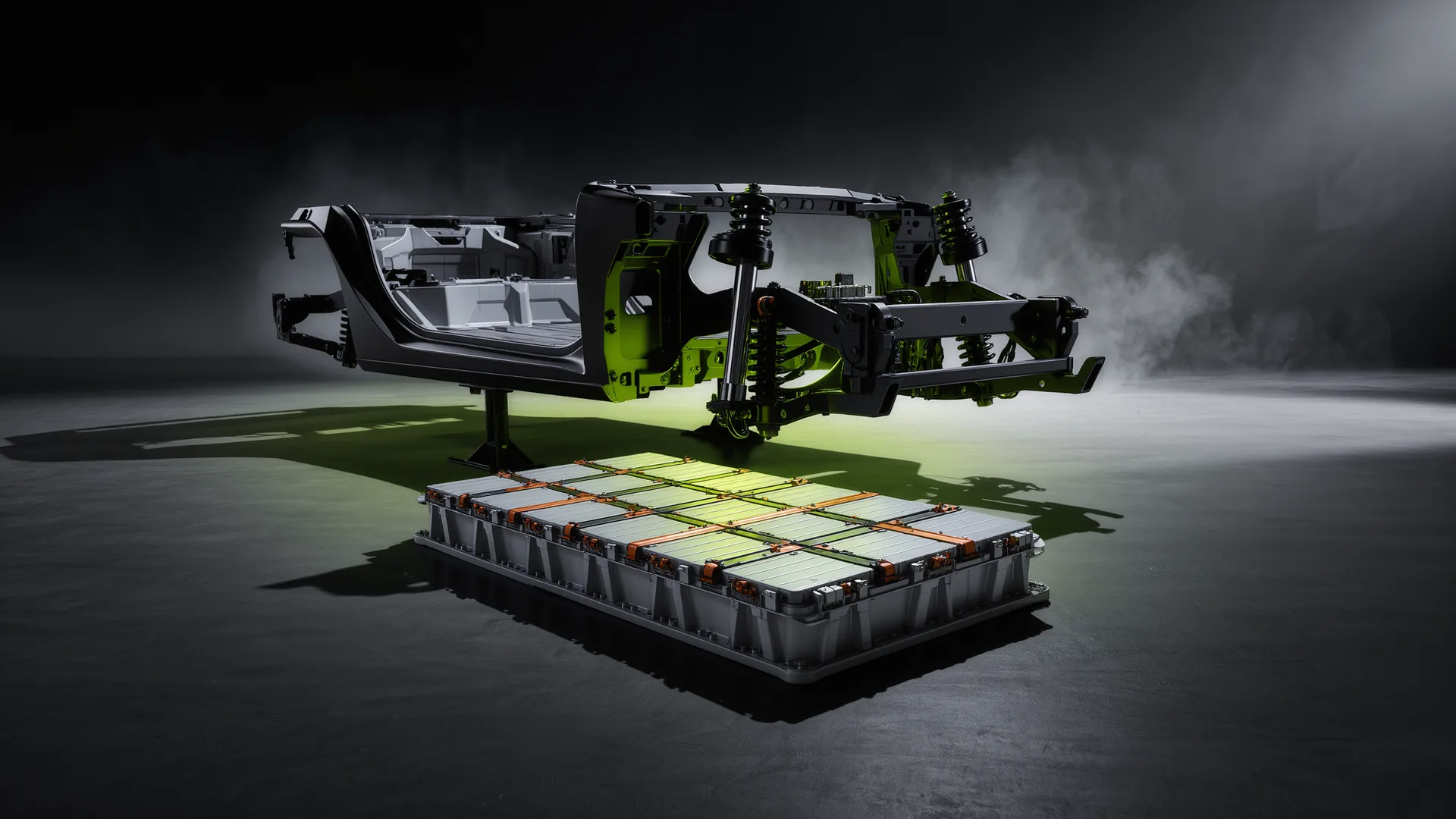
A performance electric car carries a battery of 500 to 800 kg, and that mass behaves very differently depending on what the car is being asked to do. At the launch limit it costs nothing, because maximum acceleration at the grip limit is μg and mass cancels. On a rolling acceleration run it costs everything, because the work required scales directly with mass. And under braking it costs heat: a 2,200 kg car puts 37 per cent more energy into its brakes than a 1,600 kg one.
Where the mass costs nothing
At a standing start on a grip limited surface, maximum acceleration for an all wheel drive car is the friction coefficient multiplied by gravity, and mass appears on both sides of the equation. A heavy car needs more force and its tyres are pressed down harder in exactly the same proportion. On a road tyre with a coefficient of 1.15 the ceiling is 11.28 m/s², a 0 to 100 km/h time of 2.46 s, for a 1,600 kg car and a 2,400 kg one alike.
This is the single reason heavy electric cars post acceleration figures that seem impossible for their weight. The figure is a tyre measurement, and the tyres do not care.
Where it costs a great deal
| Manoeuvre | Effect of mass | Size of the penalty |
|---|---|---|
| Standing start, grip limited | Cancels out | 0 % |
| 100 to 200 km/h | Work scales with mass | +37 % energy required |
| Braking distance at the friction limit | Cancels out | 0 % |
| Brake heat per stop | Scales with mass | +37 % |
| Cornering, through load sensitivity | Higher load per tyre lowers μ | Real, and compounding |
| Tyre wear and temperature | Scales with load | Substantial over a session |
The 100 to 200 km/h row is the honest counterweight to the launch figure. That run requires ½m(v₂² − v₁²), which is 1.85 MJ at 1,600 kg and 2.55 MJ at 2,200 kg. The heavier car needs 37 per cent more energy delivered in the same time to match, and that is a straight demand on the powertrain that no tyre can absorb.
The cornering penalty is worse than it looks
A tyre's friction coefficient falls as vertical load rises. A heavier car works each tyre at a higher load, so it operates at a lower coefficient before anything else happens. The penalty is therefore not simply that the car has more mass to turn, it is that the tyres are also less effective while turning it.
The effect compounds through weight transfer. An axle carrying 10,000 N split evenly produces more total force than the same axle split 3,000 and 7,000, and a heavier car transfers more load for the same lateral acceleration. Both mechanisms push the same way.
What the packaging gives back
The one genuine advantage is position. A battery laid flat in the floor puts a very large share of the vehicle's mass extremely low, giving a centre of gravity height no combustion car with an engine above the axle line can approach. That reduces weight transfer under braking, acceleration and cornering, which partly offsets the load sensitivity penalty.
It also raises the polar moment of inertia, because the mass is spread along the wheelbase rather than concentrated centrally. That makes the car slower to change direction and more stable once it has, which reads as composure at speed and reluctance in quick transitions.
Questions readers ask
How much do EV batteries weigh?
Between 500 and 800 kg on a performance electric car, depending on capacity and cell chemistry. That mass is fixed: unlike fuel it does not reduce as the car is driven.
Why do heavy electric cars accelerate so well?
Because a standing start is limited by tyre friction, and at the grip limit maximum acceleration is μg, in which mass cancels out. A 1,600 kg car and a 2,400 kg car with the same tyres and drive layout share the same launch ceiling.
Where does the weight actually hurt?
On rolling acceleration, where the work required scales directly with mass, and in the brakes, where heat does the same. Going from 1,600 to 2,200 kg raises the energy needed for a 100 to 200 km/h run from 1.85 to 2.55 MJ, an increase of 37 per cent.
Does weight lengthen braking distance?
Not at the friction limit, because mass cancels out of d = v² / (2a). What it changes is heat: the same stop puts 37 per cent more energy into the brakes of a 2,200 kg car than a 1,600 kg one, so fade arrives sooner on repeated stops.
Does the low centre of gravity make up for it?
Partly. A floor mounted pack puts mass lower than any engine above an axle line, which reduces weight transfer in every direction. It also raises the polar moment of inertia, so the car is more stable and less eager to change direction.
Sources
- Autosport technical forum, tyre coefficient of friction, on load sensitivity and how grip responds to vertical load.
- Vehicle Physics Pro, tyre model documentation, on weight transfer and its effect on available force.
- Commission Regulation (EU) No 1230/2012, on mass in running order, the figure such comparisons should use.
- Rimac Nevera performance records, on what a heavy electric car can achieve when the tyres are the limit.
Energy for the rolling run is ½m(v₂² − v₁²) between 100 and 200 km/h. The 37 per cent figure is the ratio of 2,200 kg to 1,600 kg.