Electric Performance
Regenerative Braking: Where the Friction Brakes Take Over
Stopping a 2,200 kg car at 1.0 g from 100 km/h needs 600 kW at the first instant. A 250 kW regen system covers 42 per cent of it, so the friction brakes still do the rest.
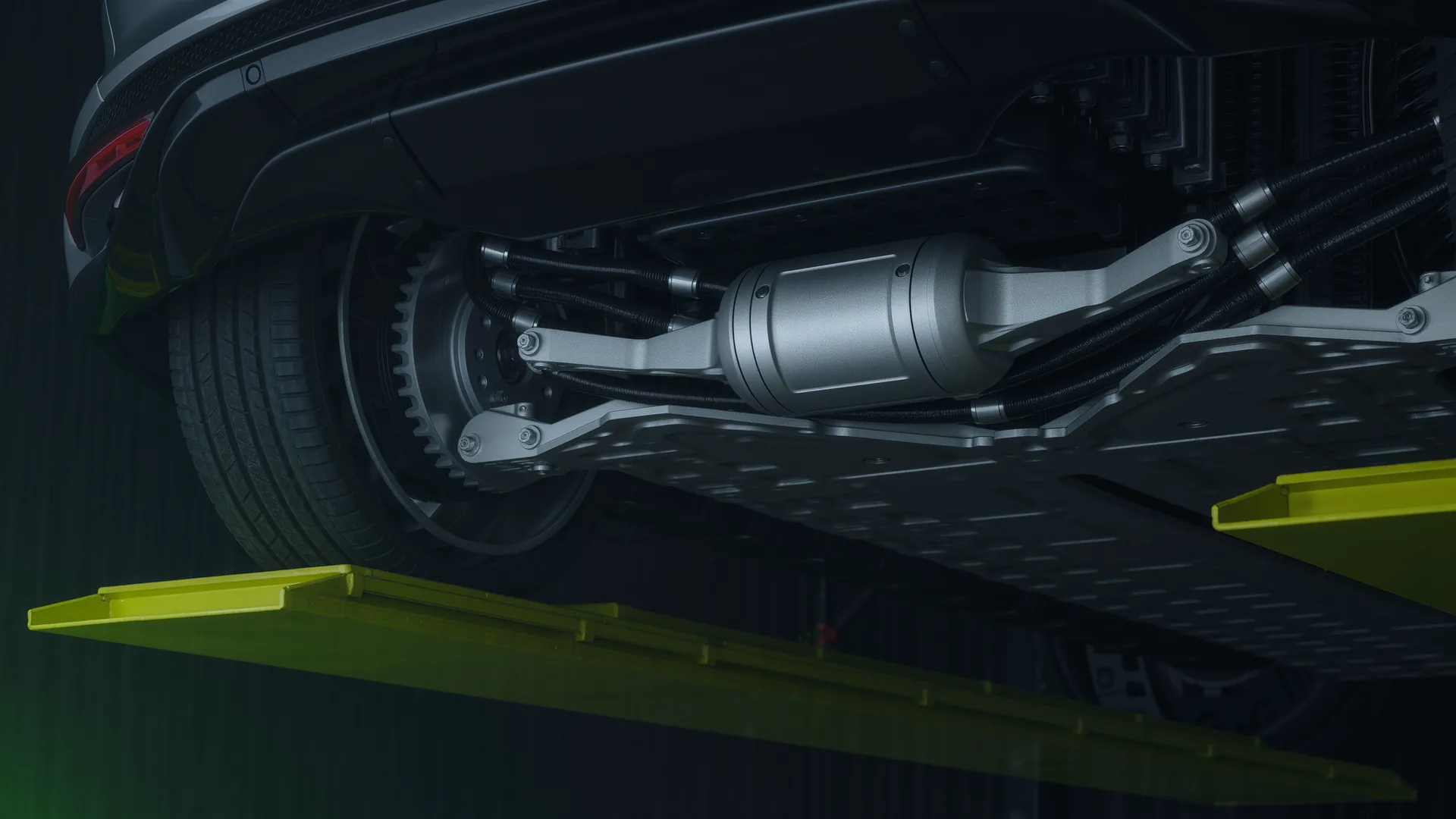
Regeneration handles ordinary braking and almost none of an emergency stop. Decelerating a 2,200 kg car at 1.0 g from 100 km/h demands 600 kW at the first instant, and a strong regeneration system delivers perhaps 250 kW. That covers 42 per cent, so the friction brakes supply the rest. At 200 km/h the same stop needs 1,199 kW and regeneration covers 21 per cent.
Braking power, which is larger than people expect
Braking power is force multiplied by speed, so it is highest at the very start of a stop and falls to zero as the car does. For a mass m decelerating at a, power is m · a · v.
| Speed | Braking force | Power required | Covered by 250 kW regen | Friction brakes supply |
|---|---|---|---|---|
| 50 km/h | 21,582 N | 300 kW | 83 % | 50 kW |
| 100 km/h | 21,582 N | 600 kW | 42 % | 350 kW |
| 150 km/h | 21,582 N | 899 kW | 28 % | 649 kW |
| 200 km/h | 21,582 N | 1,199 kW | 21 % | 949 kW |
| 250 km/h | 21,582 N | 1,499 kW | 17 % | 1,249 kW |
The force column is constant because deceleration is constant, and the power column is not, because power scales with speed. This is why regeneration feels strong in town and negligible on a motorway off ramp: the same 250 kW is most of the requirement at 50 km/h and a fifth of it at 200.
Four things cap regeneration
- Motor and inverter rating. Regeneration runs the drivetrain backwards, so it is limited by the same hardware. Many cars regenerate at less than their drive power because the thermal path differs.
- Battery charge acceptance. A cell accepts charge more slowly than it delivers it, and the limit is lower still when the pack is cold or already near full. A car at 100 per cent state of charge frequently has no regeneration available at all.
- Which axle drives. Regeneration can only act through driven wheels. On a single motor rear drive car, all regeneration is rear axle braking, exactly where load is transferring away under deceleration, so it has to be limited for stability.
- Tyre grip. Regeneration is still braking, so it is bounded by friction like everything else, and it can trigger anti-lock intervention on a slippery surface.
Blending, and why it is hard to get right
A car with regeneration has two braking systems that must add up to exactly what the pedal asked for, while the share between them changes continuously with speed, state of charge and temperature. That handover is called brake blending, and doing it badly is immediately obvious: the pedal feels inconsistent, or deceleration changes without the pedal moving.
The requirement is unforgiving because the driver's expectation is fixed. The same pedal travel has to produce the same deceleration whether the battery is empty, full, cold or hot, and the electronics have to move friction braking in exactly as regeneration falls away. It is one of the harder control problems in an electric car and it has nothing to do with performance.
How much energy actually comes back
Energy recovered is limited by the same power ceiling. In a stop from 100 km/h, a 2,200 kg car sheds 849 kJ, about 0.24 kWh. If regeneration handles 42 per cent at the start rising to most of it at the end, roughly 60 to 70 per cent comes back before conversion losses, and the round trip through motor, inverter and cells returns perhaps 70 to 80 per cent of that. The useful recovery from one hard stop is therefore around 0.12 kWh.
Over a city cycle full of gentle stops the proportion is much higher, which is why regeneration transforms urban consumption and barely touches a motorway journey. On a circuit it is close to irrelevant, because the pack is hot, the stops are violent and charge acceptance is at its lowest exactly when the most energy is available.
Questions readers ask
How much braking can regeneration do?
All of it in gentle driving and a minority of an emergency stop. Stopping a 2,200 kg car at 1.0 g from 100 km/h needs 600 kW at the first instant, and a strong system supplies about 250 kW, which is 42 per cent. At 200 km/h it is 21 per cent.
Why does regeneration feel weaker at high speed?
Because braking power is force multiplied by speed while the regeneration limit is fixed. The same 250 kW is 83 per cent of the requirement at 50 km/h and 17 per cent at 250 km/h, even though the braking force is identical in both cases.
Why does my car not regenerate when the battery is full?
Because a full pack cannot accept charge. Regeneration is limited by battery charge acceptance, which falls to nothing near 100 per cent state of charge and is also reduced when the pack is cold. The friction brakes take over completely.
What is brake blending?
The control task of making regeneration and friction braking add up to exactly the deceleration the pedal requested, while the share between them changes with speed, state of charge and temperature. Done badly it produces an inconsistent pedal.
How much energy comes back from one stop?
From 100 km/h in a 2,200 kg car, the stop sheds 849 kJ, about 0.24 kWh. Roughly 60 to 70 per cent passes through regeneration and the round trip returns perhaps 70 to 80 per cent of that, so about 0.12 kWh is usefully recovered.
Sources
- UN Regulation No. 13-H, on service braking requirements including vehicles with electric regenerative braking systems.
- UNECE Regulation No. 85, on electric drivetrain power measurement, which bounds what regeneration can absorb.
- Vehicle Physics Pro, tyre model documentation, on the friction limit that regeneration is subject to like any other braking.
Power figures are m · a · v for a 2,200 kg vehicle at 9.81 m/s². Energy in a stop is ½mv². Recovery percentages are representative rather than measured on a specific vehicle.