Electric Performance
The Fifth Run: How Electric Cars Lose Their Power
A published acceleration time is a first run figure. Heat in the cells, inverter and motors forces the control unit to reduce current, and the same car is measurably slower minutes later.
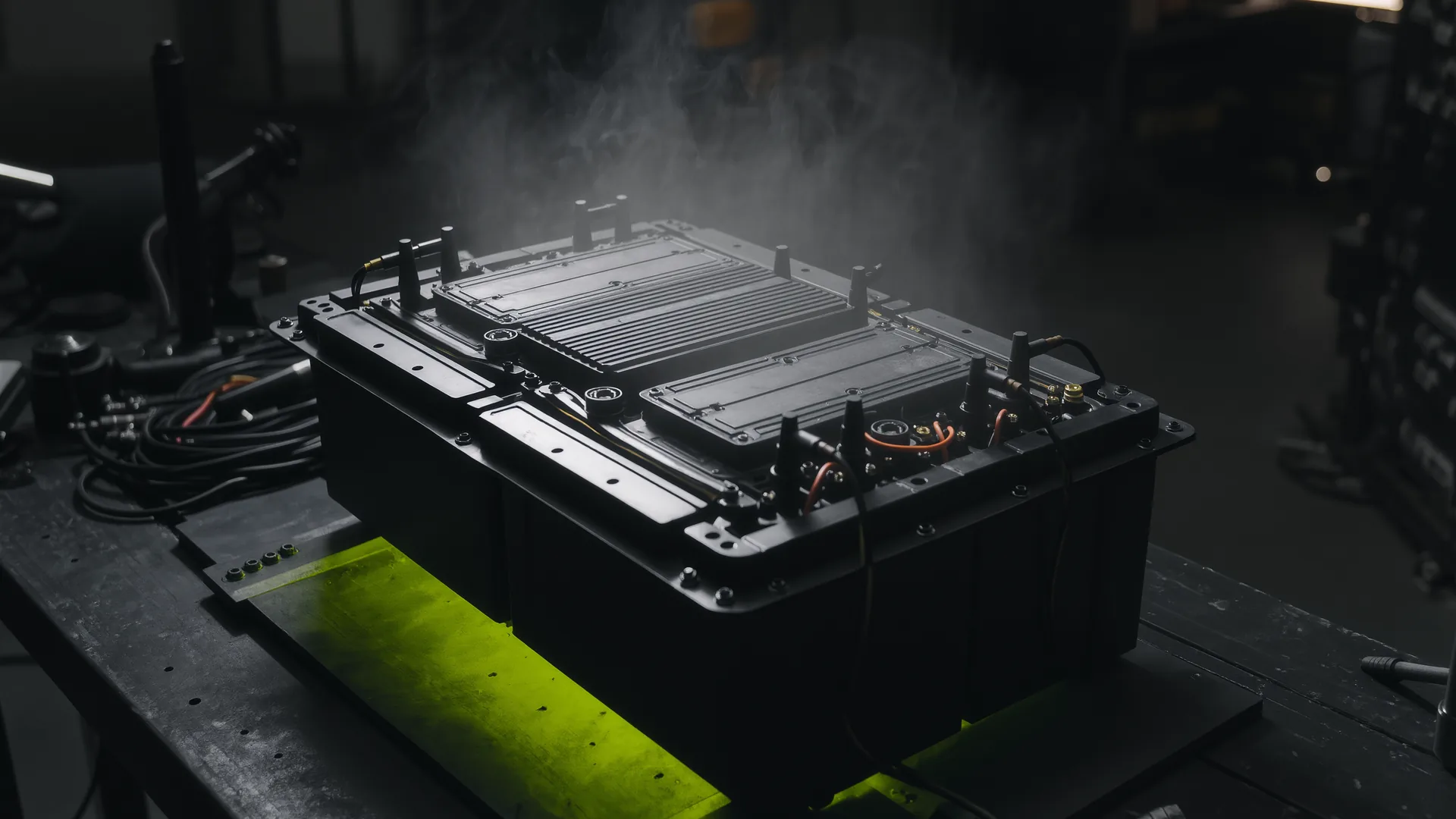
Every published electric acceleration figure is a first run number produced from a good state of charge with everything at the right temperature. Repeat it and the car slows down, because peak power is limited by heat in the cells, the inverter and the motors, and the control unit reduces available current to protect them. This is why Rimac's answer to the credibility problem was to certify 23 records in a single day rather than one figure.
Three thermal limits, not one
| Component | Heat source | Response when hot | Recovery |
|---|---|---|---|
| Cells | Internal resistance, I²R | Discharge current limited | Slow, large thermal mass |
| Inverter | Switching and conduction losses | Current limited or switching reduced | Fast, actively cooled |
| Motors | Winding resistance and iron losses | Torque reduced | Moderate |
| Coolant circuit | Rejects all of the above | Everything limited at once | Depends on ambient air |
Cell heating scales with the square of current, because power dissipated in a resistance is I²R. Doubling the current for the same duration therefore produces four times the heat. A full power launch draws the highest current the pack will ever see, so it is the most thermally expensive thing an electric car does per second.
The numbers are large. A pack delivering 500 kW at a nominal 800 V is passing 625 A. Against a pack internal resistance of even 50 milliohms, that is 19.5 kW of heat generated inside the cells, which is roughly 3.9 per cent of the power being delivered. Halve the power to 250 kW and the current halves to 312 A, but the heat falls to 4.9 kW, a quarter. The relationship is why gentle driving generates almost no thermal problem and full power driving generates one immediately.
| Power delivered | Current | Heat in the cells | As a share of output |
|---|---|---|---|
| 100 kW | 125 A | 0.8 kW | 0.8 % |
| 250 kW | 312 A | 4.9 kW | 2.0 % |
| 500 kW | 625 A | 19.5 kW | 3.9 % |
| 1,000 kW | 1,250 A | 78.1 kW | 7.8 % |
The last row is the one that shapes hypercar engineering. A pack delivering a megawatt is heating itself at 78 kW, which is more than many family cars produce in total, and all of that has to be carried away by a cooling circuit.
Why the pack is both the problem and the buffer
A performance battery of 500 to 800 kg has enormous thermal mass, which cuts both ways. It absorbs a great deal of heat before its temperature moves, so the first run and often the second are unaffected. It then holds that heat for a long time, so once the pack is genuinely warm, cooling it takes far longer than heating it did.
The practical shape is a cliff rather than a slope. Several runs at full power, then a sharp reduction, then a long wait. Owners describe it as the car suddenly feeling different, and that is accurate: the limit is a control decision taken at a threshold, not a gradual fade.
How this differs from a combustion car
A combustion car also degrades on repeated runs, and its mechanism is different. A heat soaked intercooler raises charge temperature, which brings the knock limit closer, and the engine management retards ignition. The result is a few per cent of power arriving late rather than a step reduction, and it recovers within a minute of moderate driving because the cooling system is sized for continuous full load operation.
The deeper difference is design intent. A combustion engine is built to make its rated output continuously, because that is what a motorway or a circuit demands. An electric drivetrain's peak is a short duration rating well above what it can sustain, and the gap between peak and continuous is large. That is not a defect, it is how the technology is specified, and it only becomes misleading when a peak figure is quoted as though it were continuous.
Why repeatability is the honest test
Rimac recorded a set of 23 performance records in a single day at a German proving ground, independently verified by two measurement specialists, and later a further set with the Nevera R including 0 to 400 to 0 km/h in 25.79 s. Doing that on one day, with the same car, is a claim about thermal management rather than about peak power, and it is a considerably harder claim to make.
It is also the right question to ask of any electric performance car. A single 0 to 100 km/h figure describes a moment. A set of figures produced in sequence describes the car.
What to look for
- Does the manufacturer quote a continuous power figure as well as a peak? The gap between them is the answer to most of these questions.
- Is there a preconditioning function? Its existence confirms that temperature matters enough to need managing before a run.
- How many consecutive launches are permitted? Some cars state a limit, which is more honest than a car that simply becomes slower without saying why.
- Was the published figure part of a verified set? One record is a measurement. Twenty three in a day is a system.
Questions readers ask
Why do electric cars get slower after repeated runs?
Because heat accumulates in the cells, inverter and motors, and the control unit reduces available current to protect them. Cell heating scales with the square of current, so a full power launch is the most thermally expensive thing the car does per second.
Is a published acceleration figure achievable more than once?
Usually for the first run or two, because the pack's large thermal mass absorbs heat before its temperature moves. After that the reduction tends to arrive as a step rather than a gradual fade, and recovery takes far longer than the heating did.
How is this different from a combustion car?
A combustion car loses a few per cent to a heat soaked intercooler and retarded ignition, recovering within a minute. An electric drivetrain's peak is a short duration rating well above what it can sustain, so the reduction is larger and lasts longer.
Does preconditioning help?
Before the first run, yes: it brings the pack into its window so full power is available. It does nothing about the heat generated by the runs themselves, which is what limits the third and fourth.
How can a manufacturer prove repeatability?
By producing a verified set rather than one figure. Rimac certified 23 performance records in a single day with independent measurement specialists present, which is a claim about thermal management rather than about peak power.
Sources
- Rimac Nevera sets 23 performance records in a single day, on the record set and its independent verification.
- Rimac Nevera R records, on the 0 to 400 to 0 km/h time of 25.79 s and the subsequent record set.
- UNECE Regulation No. 85, on net power measurement for electric drivetrains, including the distinction between peak and sustained output.