Lap Times
Driver Variance: Why the Same Car Loses Seconds
On a 20.832 km lap, a tenth of a second lost in each of 70 corners is seven seconds. Driver variance is the largest uncontrolled variable in any lap time comparison.
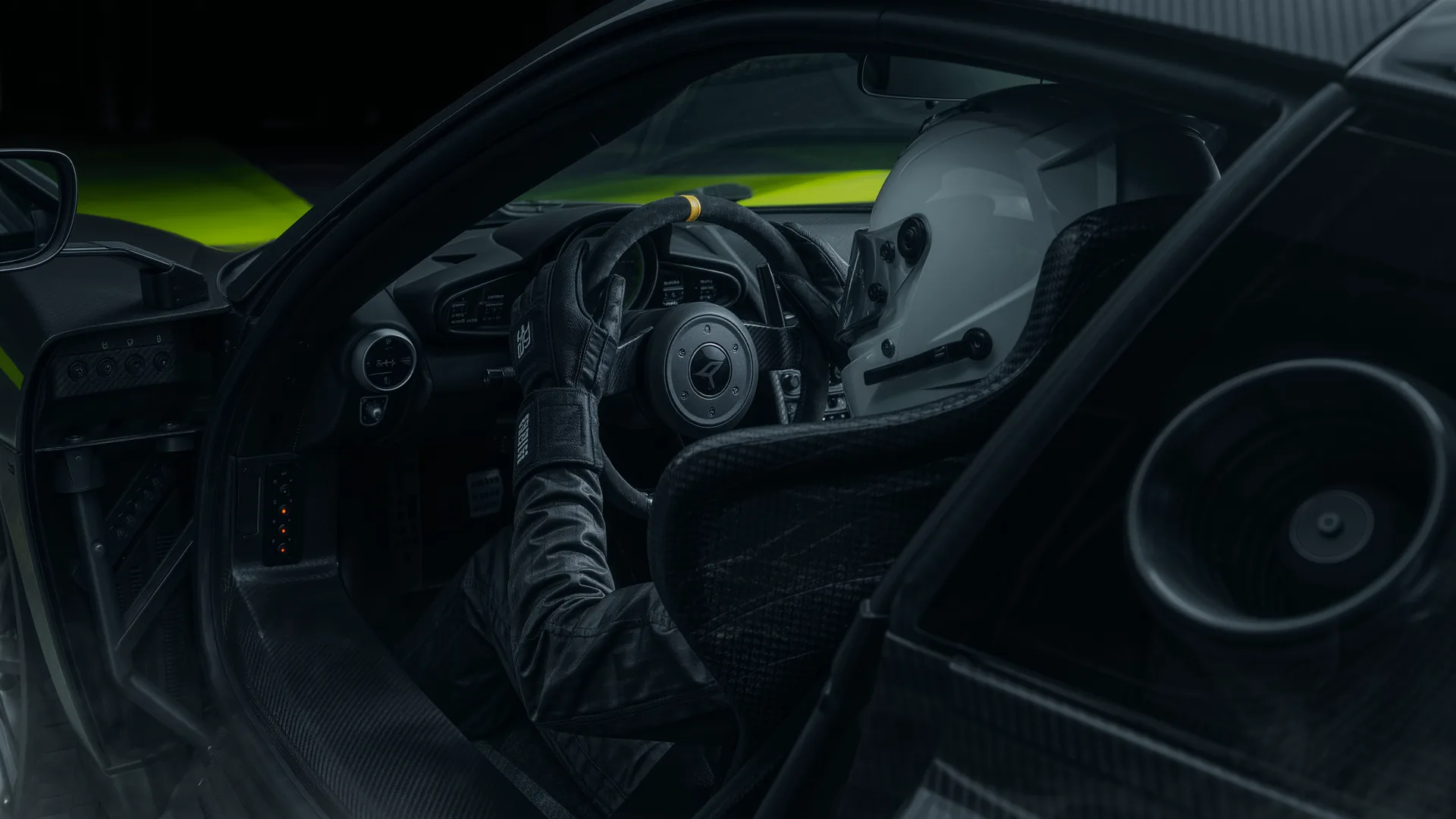
A lap time is a driver's result achieved with a car, and on a long circuit the driver's share is enormous. The Nordschleife's 20.832 km contains roughly 70 named corners. Losing a single tenth in each of them is seven seconds, which is larger than the gap between most cars in any published ranking. This is why manufacturers use the same small group of development drivers and why comparing two cars driven by different people compares the people.
The arithmetic of a long lap
Lap time error accumulates linearly with the number of opportunities to make it, and a long circuit provides a great many. The relationship is unforgiving.
| Average loss per corner | Total over 70 corners | As a share of a 6:45 lap | Roughly equivalent to |
|---|---|---|---|
| 0.02 s | 1.4 s | 0.35 % | A warm against a cold track |
| 0.05 s | 3.5 s | 0.86 % | A significant tyre change |
| 0.10 s | 7.0 s | 1.73 % | More than the gap between rival cars |
| 0.25 s | 17.5 s | 4.32 % | An entire class of car |
Two tenths of a second per corner is not a large error. It is a slightly early lift, a marginally wide entry, a fractionally late application of power. A driver making that error consistently is driving well by any ordinary standard and is fourteen seconds off the pace.
Knowing the circuit is a separate skill
The Nordschleife compounds the problem because it cannot be learned quickly. It is long, it changes elevation constantly, many corners are blind at the entry, and the correct line frequently requires committing to a direction before the exit is visible. A driver who has completed a few hundred laps and one who has completed a few thousand are not doing the same job, and the difference is not bravery, it is knowledge of where the road goes.
Manufacturers respond in the obvious way: a very small number of development drivers do the record laps, often the same individual across many years and many cars. That is good practice for producing a comparable figure within one manufacturer's own history. It also means that comparing two manufacturers' records compares two drivers as well as two cars, and nobody can quantify that term.
Why a record is one lap, and what that implies
Nürburgring record procedure requires a single timed lap over the full 20.832 km with a flying start. A single lap is the right rule, because it is unambiguous and verifiable. It also means the published figure is the best outcome of a session rather than a typical one, in exactly the way a best-of-six acceleration figure is.
The consequence is that lap records are drawn from the fast tail of a distribution, and the tail is longer for a driver who takes more risk. That is not a criticism of anybody. It is a reason to treat a two second difference between two cars as a weaker piece of evidence than it appears.
What actually makes lap times comparable
- Same driver. The only reliable control. Within one manufacturer's programme this is usually satisfied, between manufacturers almost never.
- Same distance. 20.832 km against 20.6 km is worth about 4.9 s on its own.
- Same conditions. Track and air temperature move both grip and power.
- Same tyre. A track focused compound is worth several seconds over a full lap.
- Same category. Series production, special vehicle and prototype carry different verification burdens.
Satisfy the first and the last two and a lap time comparison becomes informative. Satisfy none of them, which describes most published tables, and the ranking is measuring the sessions rather than the cars.
Questions readers ask
How much lap time is down to the driver?
On a circuit with roughly 70 corners, a consistent loss of a tenth per corner is seven seconds, which exceeds the gap between most cars in a published ranking. Two tenths per corner, still a competent lap by ordinary standards, is fourteen seconds.
Why do manufacturers use the same driver every time?
To make their own figures comparable across cars and across years. It works within one programme. It also means a comparison between two manufacturers' records includes a difference between two drivers that nobody can quantify.
Why is the Nordschleife so hard to learn?
Length, elevation change and blind corner entries. Many corners require committing to a line before the exit is visible, so the correct approach has to be known rather than seen. A few hundred laps and a few thousand laps produce genuinely different drivers.
Is a record lap a typical lap?
No. Record procedure requires a single timed lap with a flying start, so the published figure is the best outcome of a session rather than a representative one. The same caution applies as to a best-of-six acceleration figure.
What would make two lap times genuinely comparable?
The same driver, the same measured distance, similar track and air temperature, the same tyre specification and the same vehicle category. Most published comparisons satisfy none of these, which is why small differences between them carry very little information.
Sources
- Nürburgring, record drives, on the single timed lap over 20.832 km with a flying start and the categories used for classification.
- Porsche Newsroom, Panamera Nordschleife record, an example of a manufacturer using a single named development driver for record attempts.
- Bridge to Gantry, what the Industry Pool is, on the volume of manufacturer testing behind a single published lap.
The corner count is the conventional figure for the Nordschleife and varies slightly depending on which corners are counted separately. Percentages are calculated against a 6:45 reference lap.