Lap Times
How a Nürburgring Record Gets Verified
A notary supervises, calibrated equipment times it and a neutral testing organisation documents the car's standard condition. But series-production scrutineering is not required for every category.
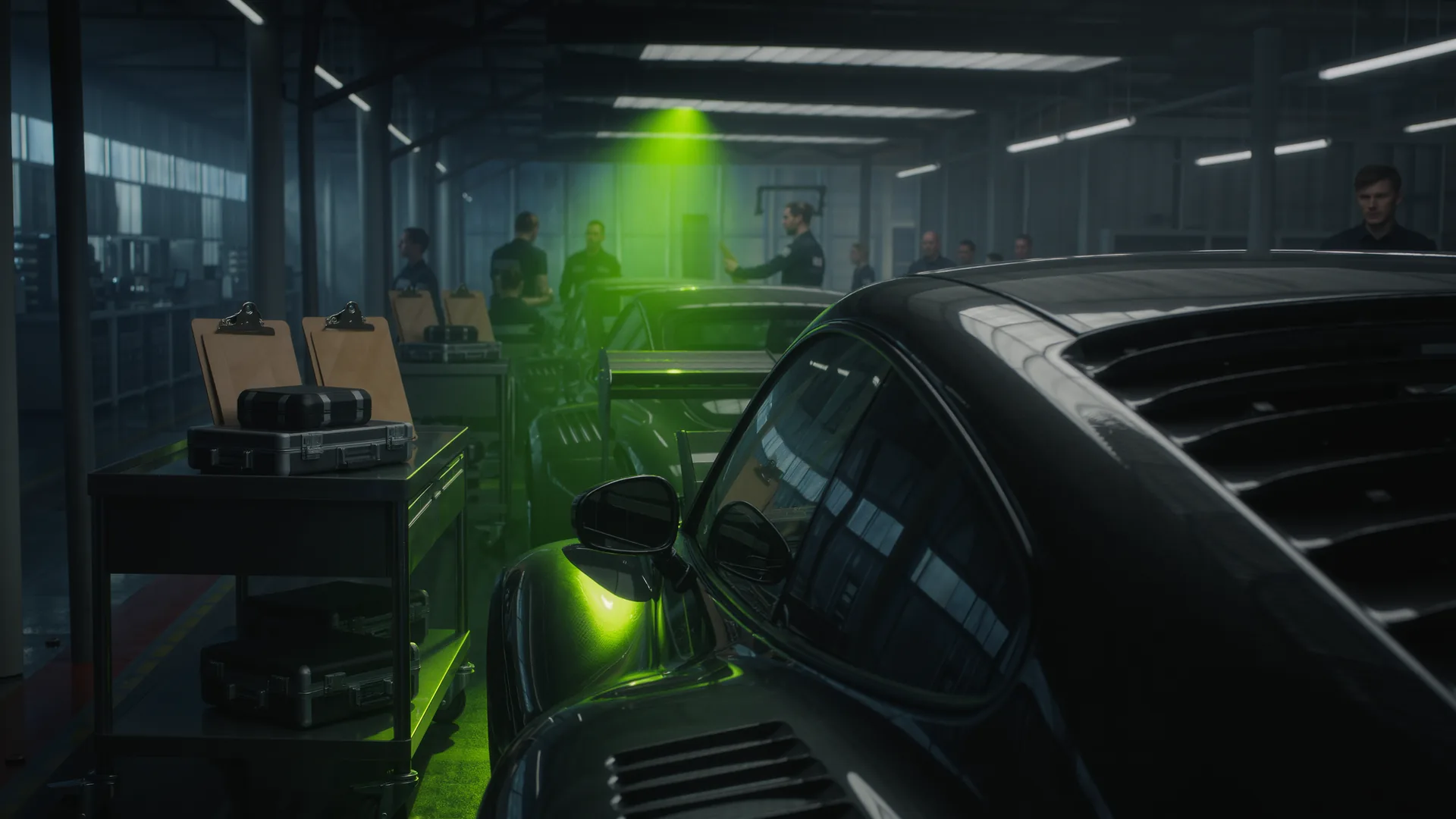
The Nürburgring runs a verification procedure that is considerably stricter than most people assume, and it has one exemption that changes how every press release should be read. Official attempts are supervised by a notary, timed with calibrated measuring technology, and the car's standard condition is documented by a neutral testing organisation. But that last step is not required for racing cars, special vehicles, prototypes and concept cars.
The four elements of an official attempt
| Element | Requirement | What it prevents |
|---|---|---|
| Distance | Full 20.832 km, flying start, line in section T13 | Times measured on a shorter reference |
| Supervision | A notary present at the attempt | Disputes about what actually happened |
| Timing | Calibrated measuring technology | Uncertified equipment and unverifiable data |
| Vehicle | Approved, standard condition documented by a neutral testing organisation | Undisclosed modification, in the categories where it applies |
| Classification | Official categories defined by the German Federal Motor Transport Authority, the KBA | Cars being compared across incompatible classes |
Taken together this is a serious procedure. A notary is an officer of the legal system rather than a marketing witness, calibrated timing removes the class of dispute that has undone top speed claims elsewhere, and a neutral organisation documenting the car's condition addresses the obvious question about what was fitted.
The exemption that carries all the weight
The rules state plainly that scrutineering regarding a vehicle's series-production state is not required for racing cars, special vehicles, prototypes and concept cars. That is entirely reasonable, because a prototype has no series-production state to verify against. It also means that a lap set by such a car is a supervised, calibrated, notarised time by a vehicle whose specification nobody independently confirmed against a production standard.
Nothing about that is improper, and the Nürburgring does not present it as anything else. The failure happens downstream, when secondary coverage compresses a carefully qualified statement into the phrase "production car record". The word to look for in an original release is the category, not the adjective.
What to check in a record announcement
- The stated distance. 20.832 km is the official one. A time quoted against 20.6 km belongs to the historical reference and is worth roughly 4.9 s of difference at typical lap speeds.
- The vehicle category. Series production, special vehicle, prototype or racing car. The verification burden differs between them, and only the first involves documented standard condition.
- Who verified it. The presence of a notary and a named testing organisation is the difference between a record and a claim.
- The tyre. Standard condition covers what was fitted, and a homologated track tyre is a legitimate factory option that is worth many seconds. It should be named.
- Conditions. Track and air temperature move lap times materially and are rarely in the headline.
Where the benchmark currently sits
The fastest street legal production car lap stands at 6:29.090, set by the Mercedes-AMG ONE on 23 August 2024. That figure is on the full 20.832 km distance under the current rules, and it sits more than ten seconds clear of the next production car, which is itself a comment on how unusual the car is.
Above that list sit faster laps by cars that are not street legal production vehicles, and those are recorded in different categories. Reading a table that mixes the two produces nonsense, which is the practical reason the KBA classification exists in the procedure at all.
It is worth putting the margins in proportion. A 6:29.090 lap over 20.832 km is an average of 192.7 km/h across roughly 70 corners and more than 300 m of elevation change. At that average, one second of lap time is 53.5 m of track, and the 232 m difference between the current distance and the historical 20.6 km reference is worth about 4.3 s. Most published gaps between rival cars are smaller than that single bookkeeping decision, which is why the procedure fixes the distance before it fixes anything else.
Questions readers ask
Who verifies a Nürburgring record?
Official attempts are supervised by a notary, timed with calibrated measuring technology, and the vehicles are approved with their standard condition documented by a neutral testing organisation. Cars are classified according to the official categories of the German Federal Motor Transport Authority.
Does every record car get scrutineered?
No. The rules state that scrutineering regarding series-production state is not required for racing cars, special vehicles, prototypes and concept cars. Those laps are still supervised, timed and notarised, but no independent body confirmed the specification against a production standard.
What is the current production car record?
6:29.090, set by the Mercedes-AMG ONE on 23 August 2024 over the full 20.832 km distance. It is more than ten seconds clear of the next street legal production car.
Do tyres count as standard condition?
Yes, which is why they should be named. A homologated track focused tyre is a legitimate factory option and is worth a great deal of lap time, so a record announcement that documents standard condition without naming the tyre has left out the most consequential detail.
Why does the classification matter?
Because the verification burden differs by category and the cars are not comparable. A prototype lap and a series production lap are both legitimate records within their own class, and placing them in one table produces a ranking that means nothing.
Sources
- Nürburgring, record drives, on notary supervision, calibrated timing, documentation of standard condition, KBA classification and the scrutineering exemption.
- Fastest Nürburgring lap times, on the current street legal production benchmark of 6:29.090 set on 23 August 2024.
- Porsche Newsroom, Panamera Nordschleife record, on the measured distance under the current statutes.