Power and Weight
Specific Output: The Engineering Bragging Right
The Mercedes-AMG M139 makes 155 kW per litre, the first road car engine past 200 hp per litre. Higher specific output than the W16 in a Chiron, from a 2.0 litre four.
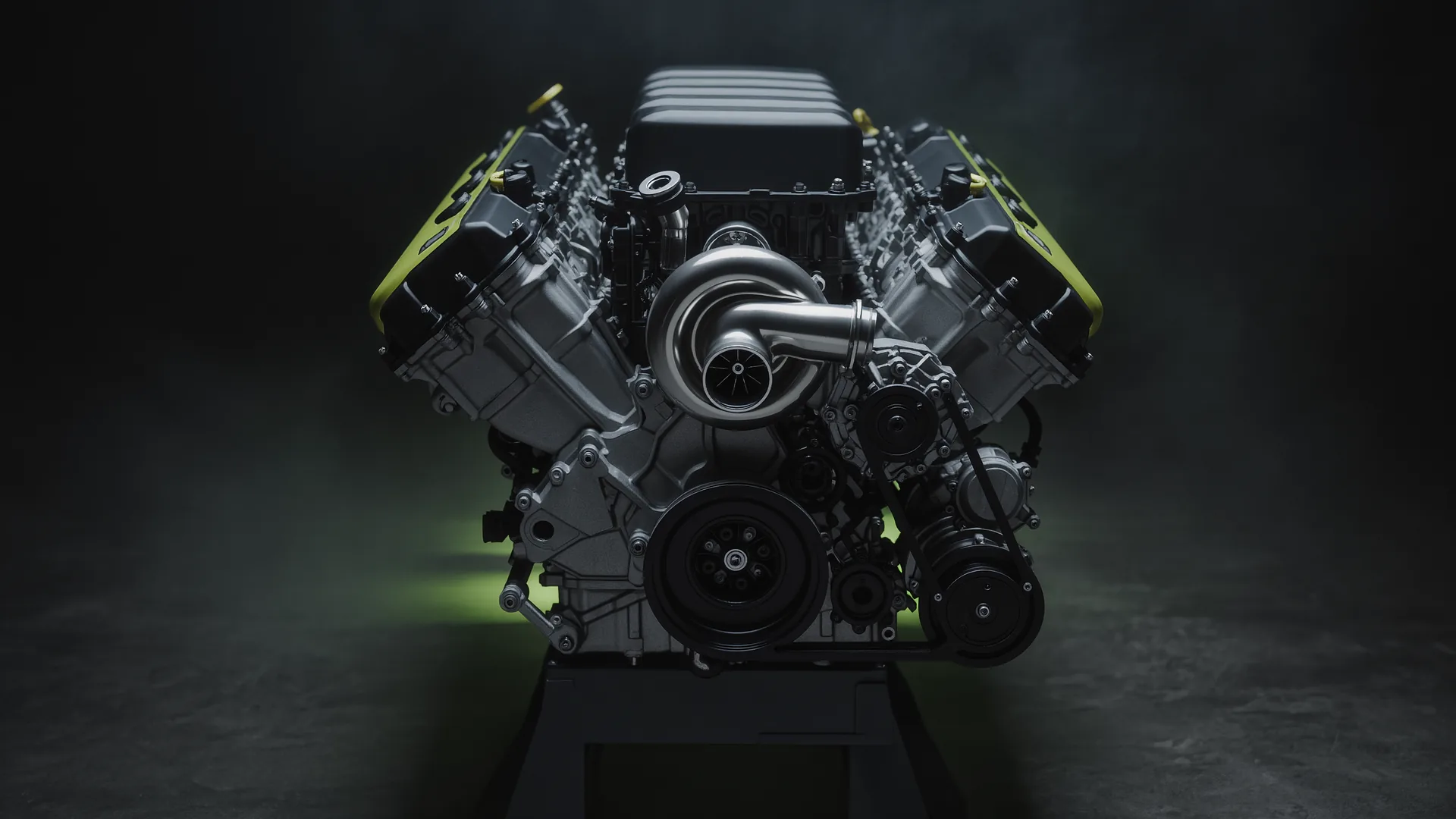
Specific output is power divided by swept volume, and it measures how hard an engine is working rather than how fast the car is. The current series production benchmark is the Mercedes-AMG M139, a 2.0 litre four producing up to 310 kW, 421 hp, which is 155 kW, 211 hp, per litre. That is the first road going production car past 200 hp per litre, and it is a higher specific output than the 8.0 litre W16 in a Bugatti Chiron.
What the number is measuring
Power is torque multiplied by rotational speed, and torque for a given engine is roughly proportional to the mass of air it can burn per cycle. So specific output resolves into two things: how much air is packed into each litre of displacement, which is boost, and how many times per minute that happens, which is engine speed. Every high specific output engine is doing one, the other, or both.
| Route | Mechanism | Typical territory | Constrained by |
|---|---|---|---|
| Engine speed | More cycles per minute | 80 to 125 hp/l | Piston speed, valvetrain, friction |
| Boost pressure | More air per cycle | 120 to 211 hp/l | Knock limit, charge temperature, thermal load |
| Both | High boost at high rpm | Racing territory | Durability and fuel quality |
The comparison that puts the M139 in perspective is a superbike engine. A naturally aspirated 1,000 cc four cylinder motorcycle engine making around 147 kW, 200 hp, is at roughly the same specific output, achieved through engine speed rather than boost, and with none of the durability, emissions or noise requirements a car engine carries.
Why it does not predict how fast a car is
Specific output says nothing about the car, because displacement is not what the car has to accelerate. A 2.0 litre engine at 211 hp per litre makes 421 hp. An 8.0 litre engine at a modest 197 hp per litre makes 1,578 hp. The second car is not marginally faster, it is in a different category entirely, and the specific output figure ranks them the other way round.
What specific output does measure is engineering intensity, and it correlates with the things that come with it.
- Thermal load. More power from the same displacement means more heat to reject through a cooling system of similar size.
- Cylinder pressure. Higher boost raises peak pressure, which drives the design of the block, head, gasket, rods and pistons.
- Fuel sensitivity. Engines close to the knock limit rely on fuel quality, and lower octane means retarded ignition and less power.
- Repeat run behaviour. An engine working hard has less thermal margin, so the third consecutive full throttle run is more likely to be derated.
Why manufacturers chase it anyway
Because emissions and taxation regimes in many markets are tied to displacement or to consumption over a certified cycle, and a small engine is favoured by both. Specific output is what allows a small engine to produce a large number, so it is a direct product of the regulatory environment rather than an aesthetic choice by engineers.
It also has a genuine engineering payoff. A smaller engine is lighter and more compact, which lowers the centre of gravity and frees packaging space. The M139's 500 Nm peak, available from 5,000 to 5,250 rpm, comes from an engine that weighs far less than a naturally aspirated engine of equivalent output would.
How to read the figure
Treat specific output as a statement about the engine and never as a statement about the car. If you want to know how fast the car is, use power against mass in running order. If you want to know how hard the engine is working, and therefore what it will be like on a hot day, on poor fuel or on its fifth consecutive run, specific output is exactly the right number.
Questions readers ask
What is specific output?
Power divided by engine displacement, quoted as kilowatts or horsepower per litre. It measures how hard an engine is working for its size rather than how fast the car is, since displacement is not what the car has to accelerate.
Which production engine has the highest specific output?
The Mercedes-AMG M139, a 2.0 litre four producing up to 310 kW, 421 hp, which is 155 kW or 211 hp per litre. It was the first road going production car engine past 200 hp per litre and exceeds the specific output of the 8.0 litre W16 in a Bugatti Chiron.
Does high specific output mean a fast car?
No. A 2.0 litre at 211 hp per litre makes 421 hp, while an 8.0 litre at 197 hp per litre makes 1,578 hp. Specific output ranks those two engines in the opposite order to the cars they power.
What are the downsides of a high specific output engine?
Thermal load, cylinder pressure, fuel sensitivity and less margin on repeated runs. An engine close to its knock limit loses power on lower octane fuel and is more likely to derate on the third consecutive full throttle run.
Why do manufacturers chase specific output?
Because emissions and taxation in many markets are tied to displacement or to consumption over a certified test cycle, both of which favour a small engine. Specific output is what lets a small engine make a large number, so it is largely a regulatory outcome.
Sources
- Mercedes-AMG 2.0 litre turbo four, on the 310 kW, 421 hp output, the 155 kW per litre specific output and the 500 Nm torque plateau.
- Mercedes-Benz M139 engine, on the engine's specification and its standing as the most powerful series production four cylinder.
- Bugatti Chiron Super Sport 300+, on the 1,578 hp figure from 8.0 litres used in the comparison.
- UNECE Regulation No. 85, on the net power standard the underlying figures are measured to.