Power and Weight
Unsprung Mass: The Kilogram That Counts Double
A kilogram in a wheel has to be accelerated in a straight line and spun up at the same time, so it costs roughly twice what a kilogram in the body does. Then it also has to follow the road.
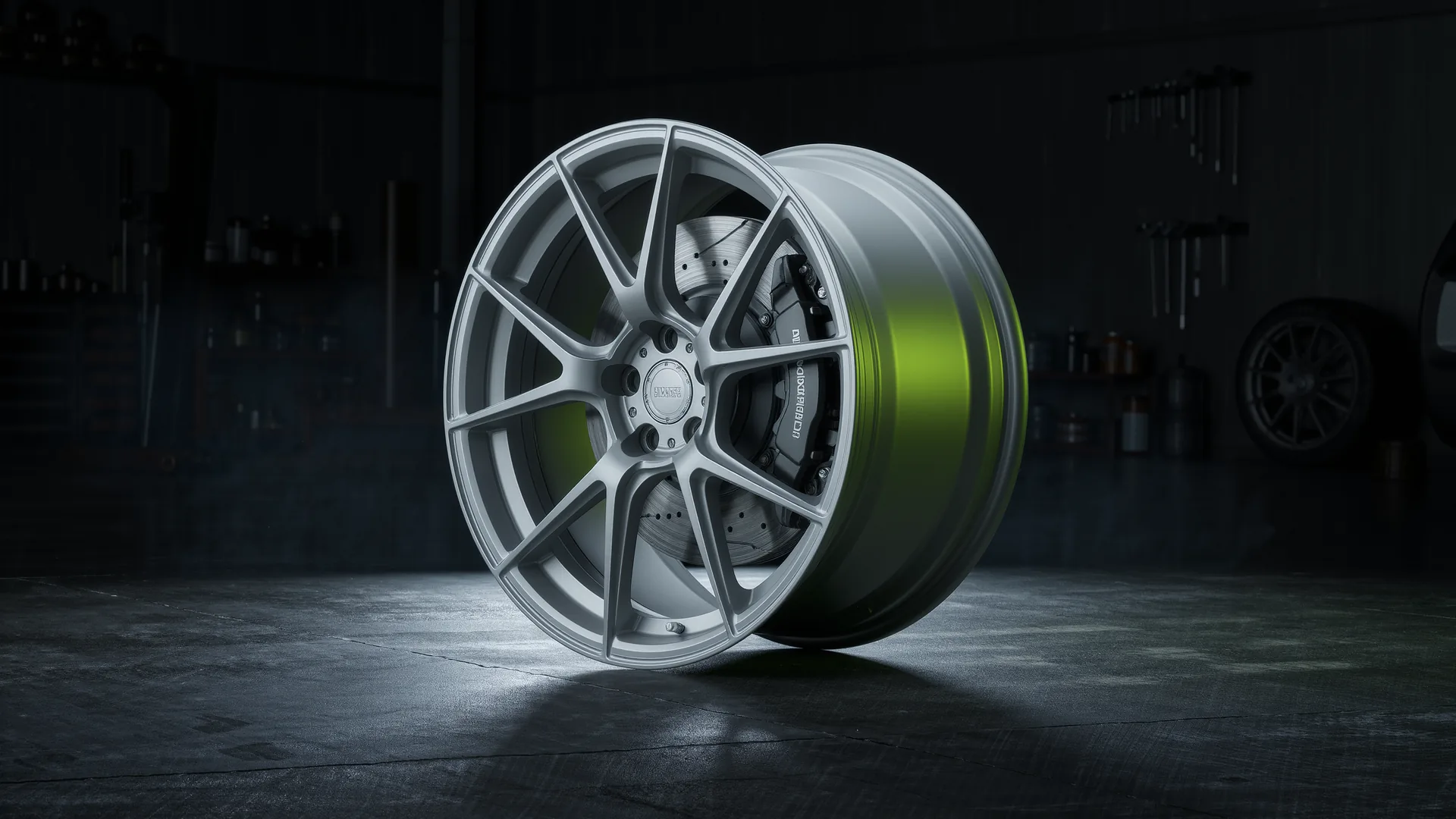
A kilogram at the wheel is worse than a kilogram in the body for two separate reasons. First, mass at the rim has to be accelerated forwards and spun up at the same time, so for a rim it costs close to double. Second, unsprung mass has to follow the road surface, and the heavier it is the worse it does that. The first effect is arithmetic. The second decides whether the tyre stays in contact with the road.
The rotational half, which is calculable
A rolling wheel stores energy twice: linear kinetic energy ½mv² because it is moving down the road, and rotational kinetic energy ½Iω² because it is spinning. For a wheel rolling without slip, ω is v divided by the rolling radius, and the rotational term becomes ½ · (I / r²) · v². The quantity I / r² behaves exactly like extra mass, and it is called effective mass.
| Location | Moment of inertia | Effective mass factor | 1 kg costs |
|---|---|---|---|
| Body or chassis | None | 1.0 | 1.0 kg |
| Hub, near the axis | Small | ≈1.1 to 1.2 | ≈1.15 kg |
| Brake disc | ≈0.5 m r² | ≈1.5 | ≈1.5 kg |
| Wheel rim | ≈0.9 m r² | ≈1.9 | ≈1.9 kg |
| Tyre tread | ≈1.0 m r² | ≈2.0 | ≈2.0 kg |
The pattern is that mass concentrated at the outer edge, where nearly all of it is at the full rolling radius, costs close to twice its weight in acceleration and braking terms. Mass at the hub costs barely more than its weight. This is why a lighter rim is worth more than a lighter hub carrier of the same saving, and why tyre weight is the most expensive weight on the car.
The suspension half, which matters more
Everything outboard of the spring and damper is unsprung: wheel, tyre, brake, hub, and a share of the suspension arms and driveshaft. When the road surface changes height, that assembly has to be accelerated vertically to follow it, and the force available to do that comes from the spring, the damper and the tyre's own stiffness.
A heavier assembly has more inertia, so it responds more slowly and overshoots more. In practice that shows up as the tyre skipping over a bump rather than following it, and a tyre in the air generates no force at all. The consequences reach everything.
- Grip on an uneven surface, because contact patch load fluctuates more and average available friction falls.
- Braking on a bumpy road, where a wheel losing contact triggers anti-lock intervention that would otherwise be unnecessary.
- Steering precision, since the front tyre's ability to hold a line depends on it staying loaded.
- Ride comfort, because impacts transmitted through a heavy unsprung assembly are harder for the damper to absorb.
This second effect is why the Nordschleife rewards suspension quality so heavily. A circuit with 20.832 km of varied and often uneven surface punishes a car whose tyres do not stay in contact, in a way a smooth modern circuit does not.
Where the savings actually come from
The available levers are wheels, tyres, brakes and suspension components, and each has a cost. Forged or flow formed wheels save several kilograms per corner over cast ones. Carbon ceramic discs weigh substantially less than iron, which is one of their genuine advantages beyond fade resistance. Aluminium or composite suspension arms save at the hub end, where the effective mass factor is lowest and the suspension benefit is still real.
The trap is larger wheels. A bigger rim with a lower profile tyre generally adds unsprung mass and moves it further out, which raises the effective mass factor at the same time, and it reduces the tyre sidewall's ability to absorb small road inputs. Fitting larger wheels for appearance costs performance twice over.
Questions readers ask
Why does unsprung weight matter more than body weight?
Two reasons. Rotating mass at the rim has to be accelerated linearly and spun up simultaneously, costing close to double, and unsprung mass has to follow the road surface. A heavier assembly follows it worse, and a tyre that leaves the road generates no force at all.
Is a kilogram at the wheel really worth two in the body?
For mass at the rim or in the tyre tread, close to it: the effective mass factor is around 1.9 to 2.0. For mass near the hub it is only about 1.15, because the rotational contribution scales with the square of the distance from the axis.
Do bigger wheels hurt performance?
Usually yes. A larger rim with a lower profile tyre tends to add unsprung mass and move it further from the axis, which raises the effective mass factor, and the shorter sidewall absorbs less of the small road inputs the suspension would otherwise not have to handle.
Where is the best place to save unsprung weight?
At the rim and in the tyre, because that is where the effective mass factor is highest at roughly 1.9 to 2.0. Lighter brake discs are next at about 1.5. Savings at the hub carrier are worth barely more than body weight in acceleration terms, though they still help the suspension.
Does unsprung mass matter on a smooth surface?
Much less. The suspension benefit only appears where the road is uneven, so on a smooth circuit only the rotational effect remains. On a varied surface such as the Nordschleife's 20.832 km, the contact effect dominates and is worth far more than the arithmetic.
Sources
- Vehicle Physics Pro, tyre model documentation, on how fluctuating vertical load affects available grip.
- Tire friction overview, on load sensitivity and why an unevenly loaded tyre delivers less than a consistently loaded one.
- Nürburgring, record drives, on the 20.832 km lap whose surface variety makes the suspension effect visible.
Effective mass factors are 1 + I / (m r²) for each component, using representative moment of inertia values for a disc, a rim and a tyre. Real values vary with construction.