Top Speed
Downforce vs Top Speed: The Trade Every Wing Makes
Downforce is produced by turning air, and turning air makes drag. A wing that gives 300 kg at 250 km/h can cost 25 km/h of top speed, which is why fast cars learned to fold theirs away.
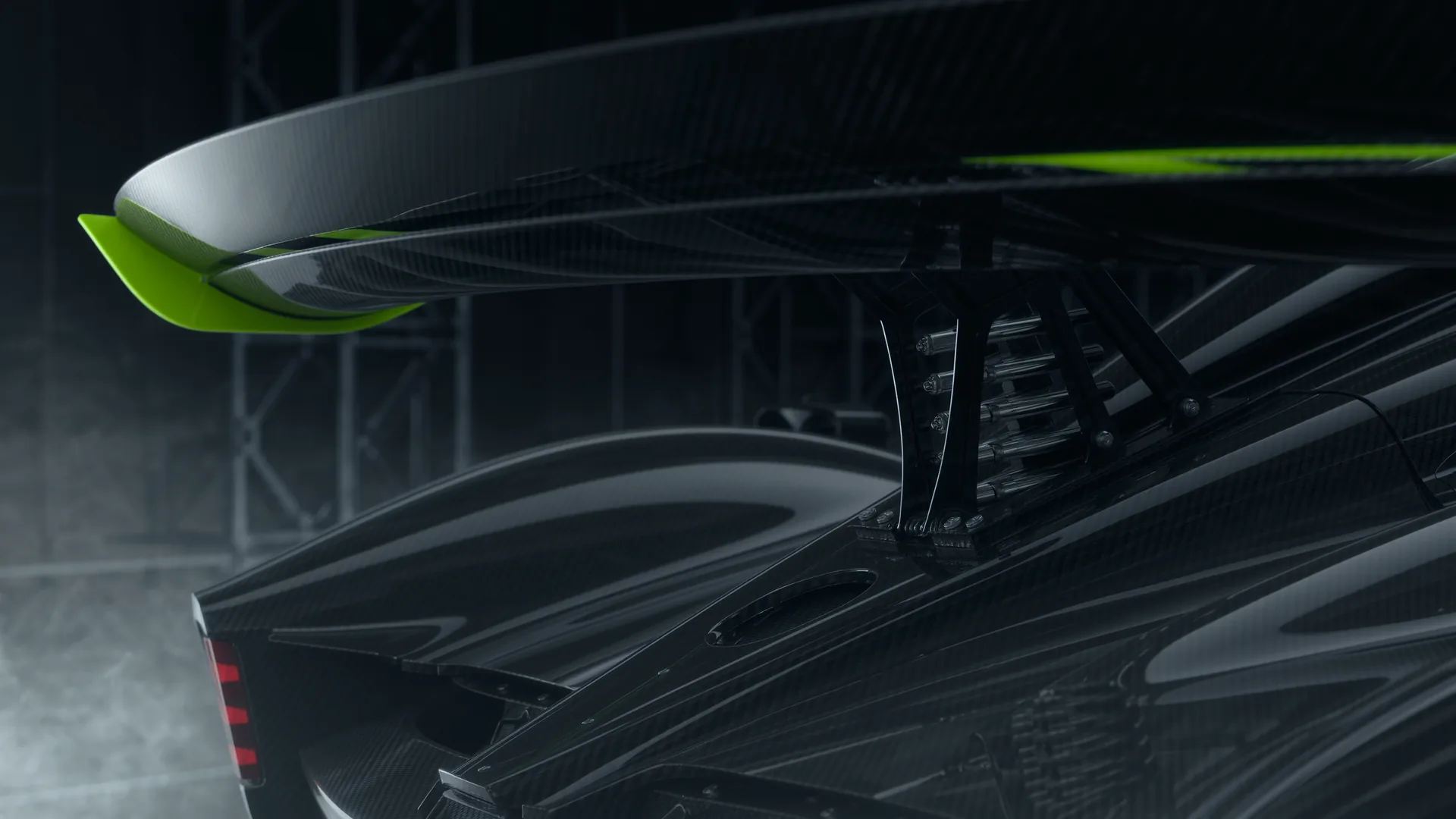
Downforce and low drag are in direct conflict, because vertical load is produced by deflecting air downward and every deflection costs momentum. Both scale with the square of speed, so a wing sized for cornering becomes an enormous penalty on a straight. A device generating 300 kg of downforce at 250 km/h will typically cost enough drag to remove 20 to 30 km/h from top speed, which is why serious cars now move their aerodynamics rather than fixing them.
Why the two cannot be separated
Downforce is L = ½ · ρ · ClA · v² and drag is D = ½ · ρ · CdA · v². The forms are identical, and that is the problem: any device that raises the first term raises the second. What separates a good aerodynamic device from a poor one is the ratio between them, the lift to drag ratio, which for a well designed racing wing lands somewhere between 3 and 5. In other words, every 4 kg of downforce arrives with roughly 1 kg of additional drag force.
That trade is excellent value on a circuit, where the downforce is converted into cornering speed and braking capacity over most of the lap. It is a straight loss on a maximum speed run, where the vertical load does nothing except press the tyres harder into the road and raise rolling resistance as well.
| Speed | Downforce | Induced drag at L/D = 4 | Extra power to carry that drag |
|---|---|---|---|
| 100 km/h | 48 kg | 118 N | 3.3 kW |
| 150 km/h | 108 kg | 265 N | 11.0 kW |
| 200 km/h | 192 kg | 471 N | 26.2 kW |
| 250 km/h | 300 kg | 736 N | 51.1 kW |
| 300 km/h | 432 kg | 1,060 N | 88.3 kW |
| 350 km/h | 588 kg | 1,442 N | 140.2 kW |
Read the last column as the entry fee. At 350 km/h, this package is consuming 140 kW, 188 hp, purely to carry the drag that comes with its own downforce. On a car with 600 kW at the wheels that is 23 per cent of the engine spent on a feature that contributes nothing to going fast in a straight line.
What active aerodynamics actually solve
The obvious answer is to have both, in different places, and that is what movable aerodynamics deliver. A wing that flattens on a straight and tilts on the brakes gives a car circuit downforce without paying for it on the straight. The mechanisms differ but the aim never does.
- Low drag mode. The wing sits near neutral incidence, downforce falls sharply and so does induced drag. This is the setting a top speed figure is measured in.
- High downforce mode. Incidence increases for cornering and stability. The drag penalty is accepted because the car is not trying to reach maximum speed.
- Air brake mode. Incidence is pushed far past the useful range so that the wing deliberately makes as much drag as possible, adding retardation under braking and, usefully, load on the rear axle exactly when weight is transferring off it.
The consequence for reading a specification is direct: a car with active aerodynamics has more than one drag figure, and its published top speed is the low drag one. Comparing that number with a fixed wing car's is comparing two different configurations.
Why fixed wings survive anyway
A fixed wing has no actuator, no control unit, no failure mode and very little mass, and on a car whose purpose is lap time rather than maximum speed the trade is straightforwardly worth it. The lost top speed is theoretical for a car that will never use it, and the extra 50 to 150 kW being spent at very high speed is money the car was not going to earn back anyway.
The reverse case is a record car, where the correct wing is no wing. The bodywork changes made for maximum speed attempts consistently point the same way: reduced downforce, reduced frontal area, closed apertures and removed mirrors, because at that end of the speed range every square metre is being paid for at the cube of velocity.
The limit on removing downforce
Downforce cannot be taken to zero, because a car body in fast moving air generates lift unless it is designed not to. A shape with net lift at 400 km/h unloads its tyres exactly when steering and braking authority matter most, and that is a stability problem rather than a performance one. Record attempts therefore aim for a small, carefully balanced amount of downforce rather than none at all, and the balance between axles matters more than the total.
Questions readers ask
How much top speed does downforce cost?
For a package generating 300 kg at 250 km/h with a lift to drag ratio of 4, roughly 20 to 30 km/h. At 350 km/h the same package absorbs about 140 kW, 188 hp, purely to carry its own induced drag.
Why do downforce and drag always come together?
Because downforce is produced by deflecting air, and deflecting air removes momentum from it, which is drag. The two share the same equation form and both scale with the square of speed. Good design improves the ratio between them, it cannot separate them.
What is a good lift to drag ratio?
Between 3 and 5 for a well designed racing wing, meaning every 4 kg of downforce arrives with about 1 kg of additional drag force. Higher ratios are achievable on aircraft wings, which operate at far lower angles and without a road surface underneath.
Why do supercars have active wings?
To avoid choosing. A movable wing sits near neutral on a straight for a low drag top speed figure, tilts for cornering downforce, and can be pushed far past its useful angle under braking to act as an air brake while adding load to the rear axle.
Can a record car run with no downforce at all?
Not safely. A car body in fast air generates lift unless deliberately shaped otherwise, and net lift at 400 km/h unloads the tyres when control authority matters most. Record cars target a small, balanced amount of downforce rather than zero.
Sources
- Bugatti Newsroom, breaking the 300 mph barrier, on the low drag configuration adopted for a maximum speed attempt.
- Ehra-Lessien, on the venue where such low drag configurations are validated at speed.
- Vehicle Physics Pro, tyre model documentation, on how added vertical load affects tyre behaviour and rolling resistance.
Table values assume a package producing 300 kg of downforce at 250 km/h, scaling with the square of speed, at a lift to drag ratio of 4 and air density of 1.225 kg/m³.