Top Speed
The Drag Equation: Why Top Speed Needs Power Cubed
Drag force rises with the square of speed and the power to overcome it with the cube. Doubling top speed needs eight times the power, which is the whole economics of a hypercar.
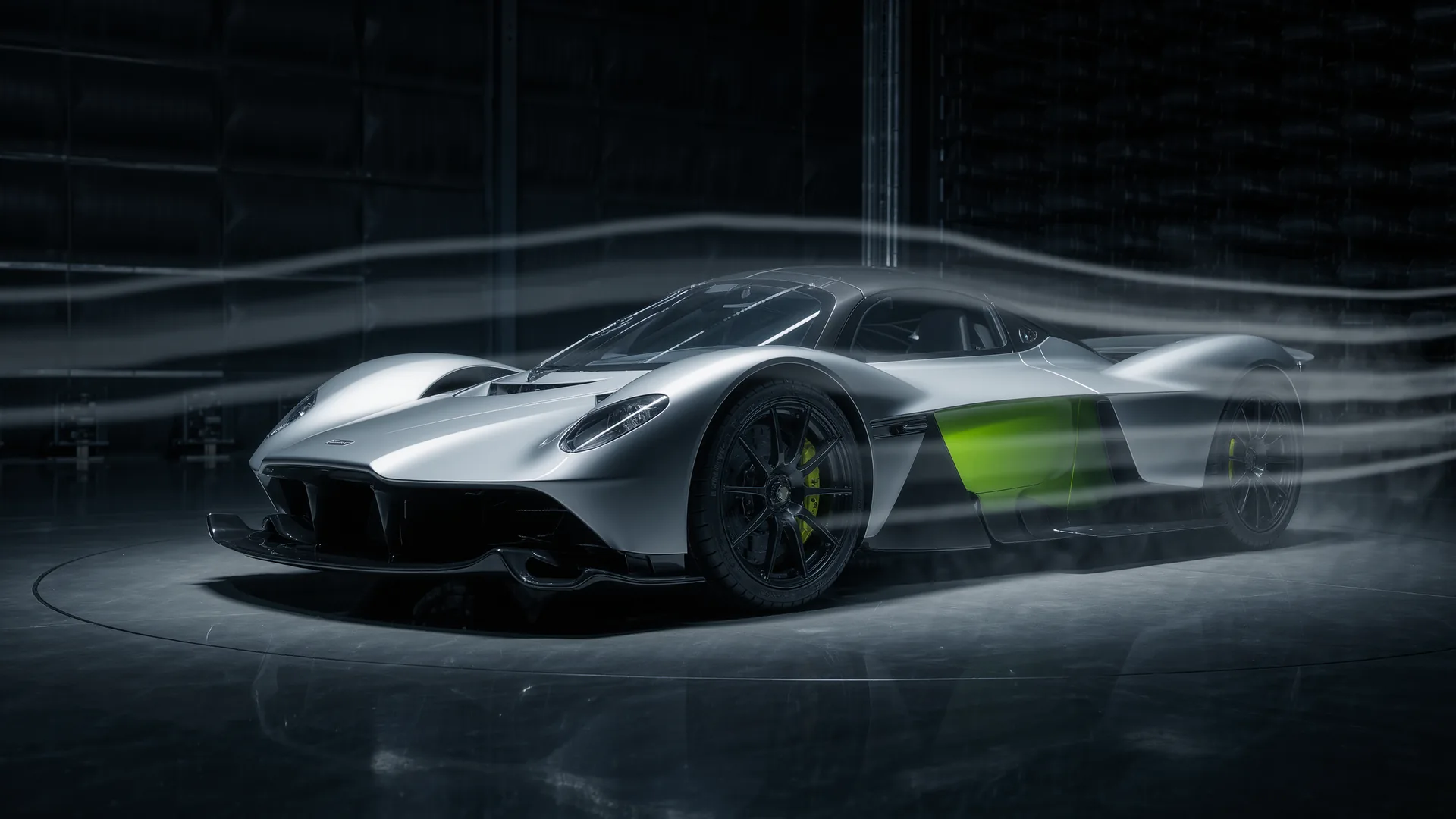
Aerodynamic drag force grows with the square of speed, and because power is force multiplied by velocity, the power needed to overcome it grows with the cube. Doubling top speed therefore takes eight times the power. That single relationship explains why a 200 km/h car needs 74 kW to hold speed and a 400 km/h car needs 588 kW, and why the last 10 km/h of any top speed figure costs more than the first hundred.
The equation, and the one term that matters
Drag force is F = ½ · ρ · CdA · v², where ρ is air density, CdA is the drag coefficient multiplied by frontal area, and v is speed through the air. Power to sustain that speed is force multiplied by velocity, so P = ½ · ρ · CdA · v³.
Three of those four terms are close to fixed for a given car on a given day. Air density at the International Standard Atmosphere sea level reference of 15 °C is 1.225 kg/m³. The shape term CdA is set by the bodywork. Which leaves the cube of speed doing all the work, and it does not negotiate.
| Speed | In m/s | Drag force | Power to overcome drag | In hp |
|---|---|---|---|---|
| 200 km/h | 55.56 | 1,324 N | 73.5 kW | 99 hp |
| 250 km/h | 69.44 | 2,067 N | 143.6 kW | 193 hp |
| 300 km/h | 83.33 | 2,977 N | 248.1 kW | 333 hp |
| 350 km/h | 97.22 | 4,052 N | 394.0 kW | 528 hp |
| 400 km/h | 111.11 | 5,293 N | 588.1 kW | 789 hp |
| 450 km/h | 125.00 | 6,699 N | 837.4 kW | 1,123 hp |
| 490 km/h | 136.11 | 7,943 N | 1,081 kW | 1,450 hp |
Compare the first and fifth rows. Twice the speed, exactly eight times the power, which is the cube law made visible. Add roughly 200 N of rolling resistance for a 1,900 kg car on performance tyres and the totals shift a little, but the shape of the curve does not change at all.
A useful check against a real record
The bottom row is worth sitting with. Holding 490 km/h against a CdA of 0.70 m² requires about 1,081 kW, 1,450 hp, at the wheels. Allow ten per cent for drivetrain losses and the crankshaft figure is around 1,610 hp.
The Bugatti Chiron Super Sport 300+ that reached 490.484 km/h at Ehra-Lessien in August 2019 was quoted at 1,578 hp. The arithmetic and the record land within a few per cent of each other, which is a reasonable indication that the simple model captures what is going on. It also shows how little margin exists at that speed: a five per cent increase in CdA would cost roughly 8 km/h of top speed on the same engine.
Why the last increment costs so much
Because power scales with the cube, the marginal cost of speed rises steeply. Turned around, extra power buys very little speed: raising top speed by ten per cent needs about 33 per cent more power, and adding fifty per cent more power buys only about 14 per cent more speed.
- From 300 to 310 km/h, a gain of 3.3 per cent, needs about 10 per cent more power, roughly 26 kW.
- From 400 to 410 km/h, a gain of 2.5 per cent, needs about 7.6 per cent more power, roughly 45 kW.
- From 480 to 490 km/h, a gain of 2.1 per cent, needs about 6.4 per cent more power, roughly 65 kW.
The same arithmetic explains why reducing CdA is so valuable at the top end. Power scales linearly with CdA but with the cube of speed, so a 10 per cent reduction in CdA is worth about 3.4 per cent more top speed for no extra power at all. On a 400 km/h car that is 14 km/h from bodywork rather than engine, which is why record cars grow long tails and shed mirrors.
What else is resisting
Drag is not the only force, it just dominates. Rolling resistance is roughly proportional to weight and only weakly to speed, so it matters at low speed and becomes a rounding error high up. For a 1,900 kg car with a rolling resistance coefficient of 0.011, that force is about 205 N regardless of speed, which is 15 per cent of total resistance at 200 km/h and under 3 per cent at 490 km/h.
Drivetrain losses take their share throughout, and tyre deformation grows sharply at very high speed as the carcass distorts under centrifugal load. That last effect is one reason top speed record attempts are as much a tyre problem as an engine problem.
Questions readers ask
Why does doubling top speed require eight times the power?
Drag force rises with the square of speed, and power is force multiplied by velocity, so power rises with the cube. Two cubed is eight. A car needing 73.5 kW to hold 200 km/h needs 588.1 kW to hold 400 km/h with the same bodywork.
What is CdA and why not just Cd?
CdA is the drag coefficient multiplied by frontal area, and it is the term that actually appears in the drag equation. A low drag coefficient on a large car can produce more drag than a higher coefficient on a small one, so Cd quoted alone cannot be compared between vehicles.
How much power does 300 km/h need?
For a CdA of 0.70 m² at sea level and 15 °C, about 248 kW, 333 hp, at the wheels to overcome aerodynamic drag, plus roughly 17 kW for rolling resistance on a 1,900 kg car. A slipperier shape needs proportionally less.
Is it cheaper to add power or reduce drag?
Reducing drag, at high speed. Power scales linearly with CdA but with the cube of speed, so a 10 per cent cut in CdA raises top speed by about 3.4 per cent, while achieving the same gain through the engine would need about 10 per cent more power.
Does rolling resistance matter at top speed?
Barely. It is roughly constant with speed while drag grows with the square, so for a 1,900 kg car it accounts for about 15 per cent of total resistance at 200 km/h and under 3 per cent at 490 km/h. At low speed it is significant, at record speed it is a rounding error.
Sources
- Bugatti Newsroom, breaking the 300 mph barrier, on the 490.484 km/h run at Ehra-Lessien on 2 August 2019 and the car's specification.
- Bugatti Chiron Super Sport 300+, on the quoted output used in the cross-check.
- UNECE Regulation No. 85, on the reference atmospheric conditions used for power figures.
Calculations use P = ½ρCdAv³ with ρ = 1.225 kg/m³ and CdA = 0.70 m². Powers are at the wheels and exclude drivetrain losses unless stated.