Top Speed
Gearing Limited vs Drag Limited: Two Ways to Run Out
A drag limited car runs out of power in top gear. A gearing limited one hits the rev limiter first. Most fast cars reach their maximum speed in an intermediate gear, not the tallest one.
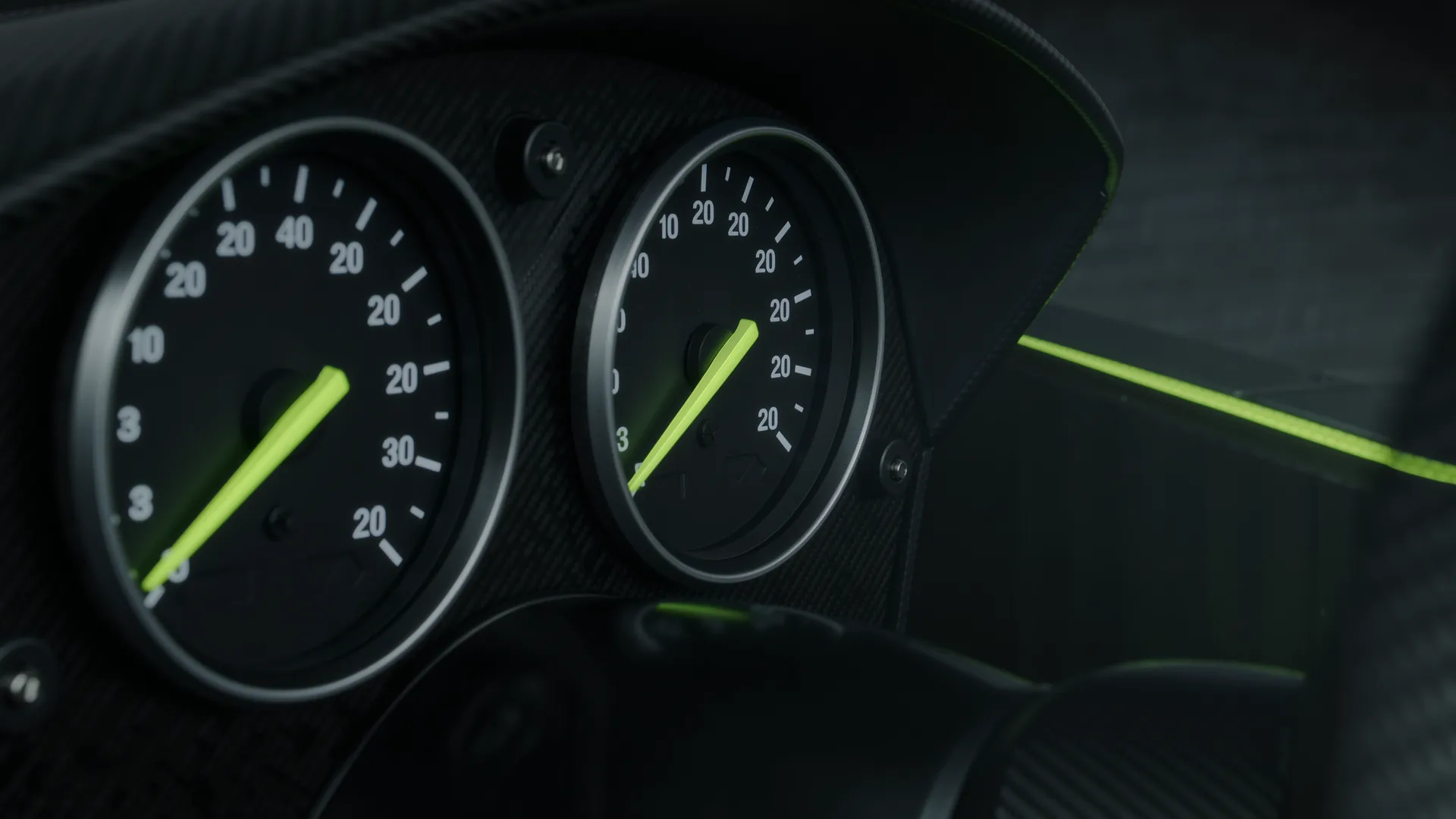
There are two entirely different ways for a car to stop accelerating. Drag limited means the engine can no longer supply the power that drag demands, and the car sits below its rev limiter in the gear it is in. Gearing limited means the engine hits its limiter before drag catches it, and the car has speed left that the ratios will not give it. Most modern fast cars are drag limited in an intermediate gear, because the tallest ratio exists for consumption rather than for speed.
Working out what a gear can give
Maximum speed in a gear is fixed by three things: engine speed limit, overall ratio and rolling circumference. Take a tyre of 295/30 R20. Rim diameter is 20 inches, 508 mm, and each sidewall adds 30 per cent of the 295 mm section width, which is 88.5 mm. Overall diameter is 685 mm and rolling circumference about 2.15 m.
With a 7,200 rpm limit and a final drive of 3.44, each gear yields a theoretical maximum:
| Gear | Ratio | Overall ratio | Wheel speed | Road speed |
|---|---|---|---|---|
| 3rd | 1.68 | 5.78 | 1,246 rpm | 161 km/h |
| 4th | 1.24 | 4.27 | 1,688 rpm | 218 km/h |
| 5th | 1.00 | 3.44 | 2,093 rpm | 270 km/h |
| 6th | 0.80 | 2.75 | 2,616 rpm | 337 km/h |
| 7th | 0.64 | 2.20 | 3,270 rpm | 422 km/h |
Now overlay the drag curve. If this car can hold 300 km/h against drag, it is drag limited in sixth: sixth would allow 337 km/h but the engine cannot supply what drag asks for above 300. Seventh is unusable at maximum speed, because in seventh at 300 km/h the engine turns only about 5,100 rpm and makes considerably less than peak power. The car's true top speed occurs one gear down from the top.
Why top gear is deliberately too tall
The tallest ratio in a modern gearbox exists to lower engine speed at cruising velocity, which reduces fuel consumption and the emissions figures measured over a certified test cycle. Those are commercial and regulatory requirements that apply to every car sold, whereas maximum speed applies to almost nobody. Given a choice, manufacturers gear for the test cycle.
The result is that eight speed and nine speed gearboxes have made the phenomenon nearly universal. A car with eight ratios rarely uses the eighth for anything but cruising, and its maximum speed will be found in sixth or seventh.
How to tell which one you are looking at
- Read the engine speed at maximum speed. Sitting well below the limiter means drag limited. Sitting on the limiter means gearing limited.
- Compare the published top speed with the gear maxima. If the quoted figure exactly matches the limiter in a gear, the car is gearing limited and the figure is arithmetic rather than aerodynamics.
- Look for a suspiciously round number. Drag limited speeds land on awkward values such as 317 km/h. Gearing limited ones fall wherever the ratio puts them, and limited cars land on 250.
- Watch what a power increase does. On a drag limited car, more power raises top speed, though only by the cube root. On a gearing limited car it does nothing at all, because the limiter arrives at the same road speed regardless.
What this means if the car is modified
The distinction decides whether a modification can work. Adding power to a gearing limited car changes nothing about its maximum speed, and the only fix is a taller final drive or a longer top gear, which costs acceleration everywhere else. Adding power to a drag limited car does raise top speed, but the cube law means a 33 per cent power increase buys about 10 per cent more speed.
The cheaper lever on a drag limited car is aerodynamic. Because power scales linearly with CdA and with the cube of speed, cutting CdA by 10 per cent is worth roughly 3.4 per cent more top speed for no additional power, which is why record cars grow long tails, lose mirrors and cover their wheel arches.
Questions readers ask
What is the difference between gearing limited and drag limited?
A drag limited car stops accelerating because the engine can no longer supply the power drag demands, and it sits below the rev limiter. A gearing limited car reaches its rev limiter first and has speed left that the ratios cannot deliver.
Why do cars reach top speed in an intermediate gear?
Because the tallest ratio is chosen to lower cruising engine speed for consumption and emissions, not for maximum speed. In that gear the engine is far below peak power at high road speed, so the car is faster in the gear below, where it can actually make what drag requires.
Will more power raise my top speed?
Only if the car is drag limited, and then only by the cube root of the power increase: about 10 per cent more speed for 33 per cent more power. On a gearing limited car more power changes nothing, because the rev limiter arrives at the same road speed.
How do I calculate maximum speed in a gear?
Divide the engine speed limit by the product of gear ratio and final drive to get wheel revolutions per minute, then multiply by rolling circumference. For a 295/30 R20 tyre at 2.15 m circumference, 7,200 rpm, a 0.80 sixth and a 3.44 final drive, the result is 337 km/h.
Is it easier to add power or reduce drag?
Reducing drag, if the car is drag limited. A 10 per cent cut in CdA raises top speed by about 3.4 per cent for no extra power, while the same gain through the engine needs roughly 10 per cent more output.
Sources
- UNECE Regulation No. 85, on net power measurement, which defines the power figure used against the drag curve.
- Goodyear, tyre sizing and speed ratings, on reading section width, aspect ratio and rim diameter to derive rolling circumference.
- The curious case of the 250 kph speed limiter, on electronically limited figures and why they conceal the real constraint.
Gear maxima are calculated as engine speed divided by the product of gear ratio and final drive, multiplied by a rolling circumference of 2.15 m. Real rolling circumference is slightly smaller than the geometric figure because of tyre deflection under load.