Top Speed
The 300 mph Barrier: What Actually Stands in the Way
Going from 250 to 300 mph needs 73 per cent more power, tyres nobody sells and about 9 km of road. Only one car has passed it, in one direction, as a modified prototype.
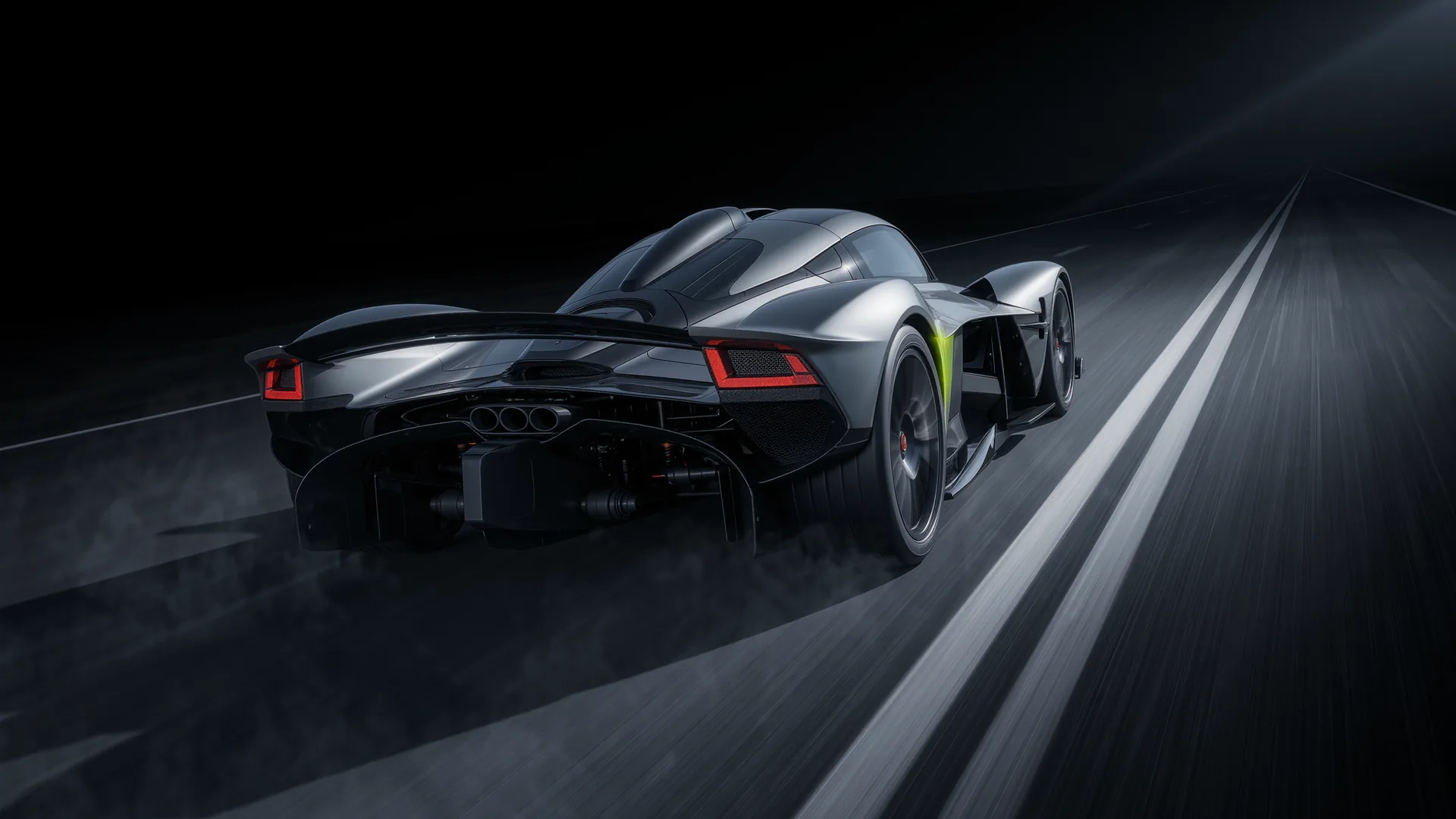
The step from 250 mph to 300 mph is a 20 per cent speed increase that demands 73 per cent more power, because drag power scales with the cube. It also needs tyres certified beyond anything on a shelf, a straight of roughly 9 km, and a body that stays planted while every aerodynamic force quadruples. One car has done it: a modified pre-production Bugatti at 490.484 km/h, 304.773 mph, in one direction, in August 2019.
The power wall
Drag power scales with the cube of speed, so the ratio between two speeds cubed gives the power ratio directly. From 402 km/h, 250 mph, to 483 km/h, 300 mph, that ratio is 1.20³, which is 1.73. Nearly three quarters more power for one fifth more speed.
| Speed | In mph | Drag power | In hp | Against 250 mph |
|---|---|---|---|---|
| 322 km/h | 200 mph | 306 kW | 411 hp | −49 % |
| 402 km/h | 250 mph | 598 kW | 802 hp | reference |
| 443 km/h | 275 mph | 796 kW | 1,068 hp | +33 % |
| 483 km/h | 300 mph | 1,033 kW | 1,386 hp | +73 % |
| 490 km/h | 305 mph | 1,081 kW | 1,450 hp | +81 % |
Allow around ten per cent for drivetrain losses and the crankshaft requirement at 300 mph is close to 1,540 hp. The Chiron Super Sport 300+ that made the run was quoted at 1,578 hp, which is the margin the whole exercise was built around: a few per cent, on a car with bodywork specifically reshaped to lower CdA.
The tyre problem, which is worse than the power problem
Standard speed rating codes stop at Y, 300 km/h, with anything above written in brackets as (Y) and certified individually. A tyre for 490 km/h is not a catalogue item, it is a bespoke development, and the physics explain why.
- Centrifugal load grows with the square of rotational speed. A tyre at 490 km/h carries 2.7 times the centrifugal loading it sees at 300 km/h, all of it trying to lift the tread away from the carcass.
- Heat generation rises with speed while cooling does not. Internal hysteresis heating accumulates faster than the carcass can shed it, and rubber loses strength as it heats.
- Failure is complete rather than gradual. There is no degraded mode at that speed, which is why record attempts inspect or replace tyres between passes and why the tyre supplier is a full partner in any such programme.
Aerodynamic stability, where the margin disappears
Every aerodynamic force scales with the square of speed, so going from 250 to 300 mph multiplies all of them by 1.44. A small front lift tendency that is harmless at 200 mph becomes a control problem at 300. Ride height changes as the suspension compresses under load, which alters the underbody flow, which alters the load, and that loop can run in an unhelpful direction.
Meanwhile the car needs the smallest CdA it can manage, and the two requirements pull apart: stability wants downforce and speed wants none. Record configurations settle on a small amount of carefully balanced downforce, with mirrors removed, apertures closed and ride height fixed, which is a specification no customer car carries.
Distance, and the reason so few venues qualify
Acceleration collapses as the car approaches its limit, because the surplus between engine power and drag power shrinks toward zero. The final 20 km/h can take more distance than the first 200 km/h did, so the venue has to be long enough for the car to genuinely stop accelerating. Ehra-Lessien's straight of about 9 km is the reference, and it is a private facility.
Stopping is the mirror image. Kinetic energy scales with the square of speed, so slowing from 490 km/h dissipates 2.7 times the energy of a stop from 300 km/h, and it has to be done gently enough to leave the tyres intact.
What has and has not been done
Three claims are commonly muddled, and separating them is the point of the exercise.
- Bugatti, August 2019: 490.484 km/h, 304.773 mph at Ehra-Lessien, recorded by a sealed GPS box and certified by an independent testing organisation. One direction, modified pre-production car. A genuine milestone, not a two way production record.
- Koenigsegg, November 2017: 447.19 km/h, 277.87 mph, a two way average from passes of 284.55 and 271.19 mph on a closed public road. Below 300 mph, and a properly constituted record.
- SSC, 2020 and 2021: a claimed 316.11 mph two way average, withdrawn after the data failed to support it, followed by a verified 282.9 mph in January 2021 with independent equipment and certification.
Read together, the three explain why the barrier is still standing. Nobody has produced a two way average above 300 mph with independent verification.
Questions readers ask
Why is 300 mph so much harder than 250 mph?
Because drag power scales with the cube of speed. Going from 250 to 300 mph is a 20 per cent speed increase that needs 73 per cent more power, roughly 1,386 hp at the wheels for a CdA of 0.70 m², before drivetrain losses.
Has any car passed 300 mph?
One pass has. A modified pre-production Bugatti Chiron Super Sport 300+ reached 490.484 km/h, 304.773 mph, at Ehra-Lessien on 2 August 2019, in one direction, certified by an independent testing organisation. No two way average above 300 mph has been independently verified.
Why are tyres the limiting factor?
Standard speed ratings stop at Y, 300 km/h, with higher ratings certified individually. Centrifugal loading grows with the square of rotational speed, so a tyre at 490 km/h carries 2.7 times the load it sees at 300 km/h while internal heating outpaces its ability to cool.
How much road does a 300 mph run need?
Around 9 km of straight, which is why Ehra-Lessien keeps appearing. Acceleration collapses near the limit, so the last 20 km/h can consume more distance than the first 200, and stopping from 490 km/h dissipates 2.7 times the energy of a stop from 300.
Could a production car do it?
Not as delivered. The successful pass used reshaped bodywork for lower drag, bespoke tyres, a fixed ride height and removed mirrors, on a private proving ground. Those are configuration changes no customer car carries, which is precisely why the run was presented as a milestone rather than a production record.
Sources
- Bugatti Newsroom, breaking the 300 mph barrier, on the 490.484 km/h pass, its single direction and its certification.
- Koenigsegg Agera RS speed records, on the 447.19 km/h two way average and the individual passes.
- SSC Tuatara retakes the record, on the withdrawn 316.11 mph claim and the verified 282.9 mph figure.
- Ehra-Lessien, on the length of the straight and the nature of the facility.
Power figures use P = ½ρCdAv³ with ρ = 1.225 kg/m³ and CdA = 0.70 m², at the wheels, excluding rolling resistance and drivetrain losses.